


Call Us
+86-19518020980
Email Us
chloe@kebonfirstaid.com

China Factory Holidays 2027: First Aid Kit Order Cutoffs
China's Factory Holiday Calendar: First Aid Kit Order Deadlines for Golden Week and Chinese New Year 2027
Twice a year, the world's largest manufacturing base stops — and every year, a new group of importers discovers it the expensive way. A purchase order placed in January with a "30-day lead time" arrives in April. A quote issued in late September quietly expires inside a national holiday. A container misses the pre-holiday vessel and sails three weeks late.
None of this is a supplier being dishonest. All of it is a calendar that can be read in advance.
We manufacture first aid kits in Yiwu, China, and we watch this cycle repeat every year — including the part where buyers plan around Chinese New Year and then get surprised by Golden Week. This article lays out the real production calendar, what each holiday actually does to your order, and a backward-planning method you can use today.
1. The holiday is seven days. The disruption is three weeks.
The most common planning error is treating a Chinese public holiday as a closed period of exactly its official length. It is not. Every significant holiday produces three phases, and only the middle one is the holiday.
The rush, before. Factories push to clear pending orders before they close. If your order is already in the queue, this is good news. If you are still negotiating specifications in the week before, your project simply does not start until after the holiday — which means you have added the entire shutdown to your lead time without noticing.
The closure itself. Production stops. So does a surprising amount of everything else: customs documentation teams, inland trucking, banking, third-party inspection companies, and the wholesale component markets that supply smaller factories. A factory that is technically "open" cannot produce without components.
The slow restart, after. Workers return staggered, and historically a meaningful share do not return at all. Lines restart short-handed, then requalify. Full rhythm typically returns two to four weeks after the holiday ends.
That is the pattern. What changes each time is the size of it.
2. What is happening right now, in the last week of September 2026As this is written, we are inside the narrowest production window of the year, and the numbers from this month tell the story better than any general advice.
The calendar compressed. Mid-Autumn Festival fell on 25–27 September 2026. That leaves 28, 29 and 30 September as the only three ordinary working days before National Day Golden Week (1–7 October). For anything that was meant to ship before the holiday, inspection, documentation, customs, VGM and trucking all had to fit into those three days. That is the choke point.
Carriers cut capacity ahead of it. Shipping Gazette data for the 14 September – 18 October window shows 721 scheduled sailings with 79 cancellations — an 11 percent cancellation rate, roughly a third of them on Asia–North Europe and Asia–Mediterranean services. Maersk cut sailings on AE15 out of Qingdao, AE12 out of Ningbo on 8 October and AE1 out of Shanghai on 10 October.
Origin ports were already congested. Shanghai's average waiting time rose to 78 hours in Week 37, and the post-typhoon backlog earlier in September pushed some Shanghai and Ningbo delays past ten days. Pre-holiday cargo had to clear a congested port and a reduced sailing schedule in the same fortnight.
Rates moved twice this month. Two rounds of General Rate Increases of roughly USD 500 per TEU took effect on 1 September and again on 15 September. ANL confirmed a Rate Restoration programme effective 15 October for shipments from China, Southeast Asia, North East Asia, the Indian Subcontinent and the Middle East, and a late-season Peak Season Surcharge window has been forecast from mid-October through mid-November, timed to the Q4 retail peak. Equipment is tight too: 40HC availability at Chinese ports has not improved in line with new vessel capacity.
The practical lesson: booking lead time has moved. What used to be a one-week booking habit now needs two to three weeks, even for cargo that is not yet ready. Securing space early costs nothing; finding space late costs the rate plus a rollover.
Shipping in the next few weeks and not sure your order will make a sailing? Tell us your target delivery window and we will give you an honest ex-works date and the sailings it can realistically connect to — before you commit the order.
3. The full year: six holidays, two of them serious
Most importers plan around Chinese New Year only. There are six public holidays that affect factory output, and while four of them are minor, they matter when your schedule is already tight.
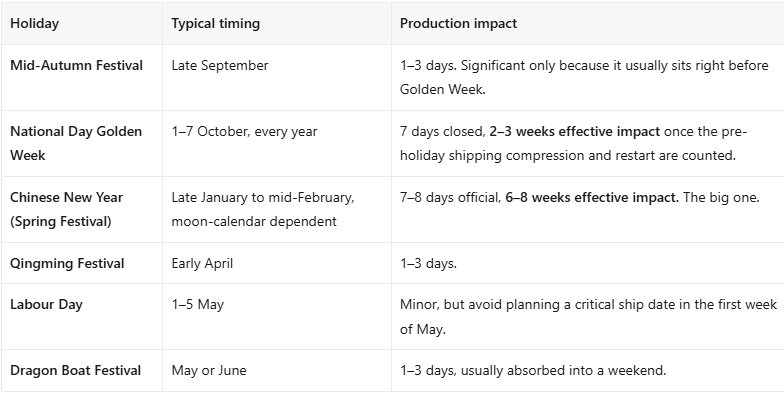
Golden Week is fixed and predictable, which is its one mercy. Chinese New Year moves every year, which is why it catches people out.
4. Chinese New Year 2027: the eight-day holiday that costs six weeks
Chinese New Year 2027 falls on 6 February 2027. Factories begin winding down from mid-January, the official holiday runs approximately 5–12 February, and most lines do not return to full capacity until early to mid-March.
That is a total disruption window of six to eight weeks — for an eight-day holiday.
Three mechanics explain the gap, and each one is worth understanding because each one is a question you can ask your supplier in advance.
Chunyun. The Spring Festival travel rush is the largest annual human migration on earth. Workers travel from factory cities back to their home provinces, and they do not all come back on schedule. A factory's official reopening date and its real production date are frequently different things.
Worker attrition. Historically, a meaningful share of factory workers — industry estimates commonly put it between 10 and 30 percent — do not return to the same factory after Chinese New Year. The workers who do return are requalifying on your product, and the workers who replaced them are new to it. This is the single most important quality window in the Chinese manufacturing year.
Component suppliers close too. Moulds, plastics, packaging, printing, hardware — the smaller workshops further down the supply chain often close earlier and reopen later than the assembly plant. A factory that is "back" may still be waiting for parts.
What this means for your order: a production lead time quoted in December can stretch to eight or ten weeks in January. A nominal 30-day order placed in mid-January can reasonably deliver ninety days later.
5. Backward planning: when to place your order
Working back from when you need goods, using a standard first aid kit with roughly 30 days production and 30–35 days sea freight to Europe or North America.
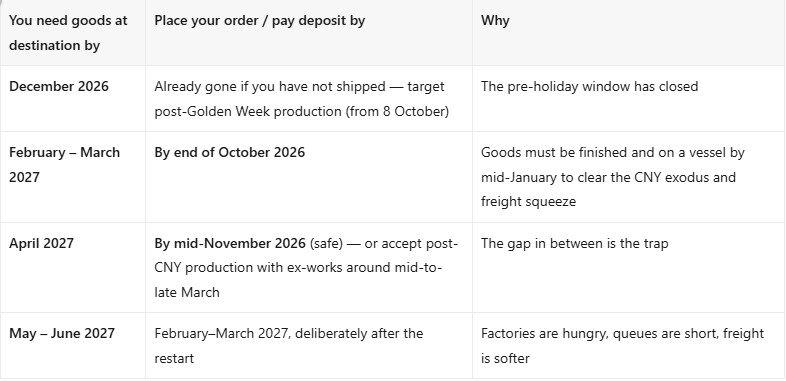
The third row is the one that costs people money. The worst possible moment to place an order is roughly mid-December to mid-January. It is too late for pre-CNY production, so the order sits through the rush, the shutdown and the restart — and a 30-day order delivers in 90.
Experienced importers do one of two things instead: they cover their Q1 demand with a larger order shipped in October or November, or they deliberately schedule for the post-restart window and carry more safety stock through the first quarter.
6. Documents are the other half of the problem
A shipment that arrives during or just after a Chinese holiday still needs to clear customs at destination — and if the commercial invoice, packing list, bill of lading or compliance documentation is incomplete, the delay lands on you.
The specific risk is this: if a document has to be corrected or reissued by the supplier during the closure, nobody is at a desk. Cargo then sits past its free days at the terminal, and demurrage and storage charges accumulate against a shipment that was otherwise perfectly on time.
Two habits prevent almost all of it:
Confirm document completeness before the holiday, not after. For any shipment arriving around a holiday window, check that every document is issued and correct before the factory closes.
Get the ex-works date in writing, holiday-adjusted. A quote issued between October and January should state its ex-works date explicitly accounting for the holiday. The question to ask is simply: "Does this lead time cross the holiday, and does it include the restart?"
7. Quality control: the two windows where defects rise
If you run third-party inspections, plan around two periods.
The two weeks before Chinese New Year. Everyone is overloaded at once, and corners get cut industry-wide during the pre-holiday rush. Defect rates in orders produced in this window are consistently higher.
The first batch after the restart. With 10–30 percent of workers replaced, early-batch defect risk is elevated. Always schedule a production-stage inspection for your first post-CNY batch, not just a pre-shipment one.
One practical note: third-party inspection companies suspend operations during Chinese New Year as well. Complete pre-shipment inspections before mid-January 2027, or plan for March 2027 onwards.
8. How we plan around this at Kebon
We manufacture first aid kits and first aid supplies in Yiwu, China — around 100 staff in a 5,000 m² facility, with ISO 13485, CE, FDA and UKCA certification, shipping to importers, distributors and private-label brands across North America, Europe, the Middle East and Canada.
The holiday calendar is not a surprise to us. What we can offer a buyer planning around it:
**Honest, holiday-adjusted ex-works dates in writing. If a lead time crosses a holiday, we say so and price the restart into the date rather than discovering it later.
**Production slot holding before Golden Week and Chinese New Year. We would rather tell you a real date now than hold a slot we cannot deliver on.
**Documentation completed before the closure. Invoices, packing lists, certificates of origin and compliance paperwork issued and checked while our office is still staffed — so your clearance is not waiting on a locked office.
**Pre-holiday inspection scheduling. We build the inspection window into the production plan instead of hoping it fits.
**A broad product matrix so one supplier can carry your full line through a season: workplace medical first aid kits, industrial first aid kits, advanced wound closure kits, tactical and trauma packs and car emergency rescue kits
MOQ is 500 units and standard production lead time is around 30 days. If you are planning Q1 or Q2 2027, that 30-day figure is the number that has to fit before mid-January — which means the ordering conversation belongs in November 2026, not January.
Planning Q1 or Q2 2027 inventory? Send us your target quantities and destination and we will map them against the holiday calendar and return a production and shipping schedule with real dates — including which orders need to be placed before the Chinese New Year window closes.
9. Frequently asked questions
When is Chinese New Year 2027?
6 February 2027 is New Year's Day, with New Year's Eve on 5 February and the official public holiday running approximately 5–12 February. Factories begin slowing from mid-January and typically reach full capacity again in early to mid-March.
When is Golden Week 2026 and 2027?
Golden Week falls on 1–7 October every year, in both 2026 and 2027. It is fixed to the calendar, unlike Chinese New Year.
How far in advance should I place an order to avoid Chinese New Year delays?
For sea freight, place orders by November to December 2026 if your production lead time is 30 days or more. For air freight, late November to December 2026 depending on lead time. Work backward from your required delivery date using production time plus transit time plus a two-to-three week holiday buffer.
Will my supplier tell me if my lead time crosses the holiday?
Not always, and usually not deliberately — a quote issued in a busy period often carries a standard lead time without a holiday adjustment. Ask directly: "Does this lead time cross Chinese New Year, and is the restart included?" Get the answer in writing.
Does Golden Week affect shipping, or only production?
Both. Factories close, but carriers also blank sailings across the holiday period, origin ports run congested in the final working week, and backlogs continue into mid-October. The pre-holiday shipping compression typically starts two to three weeks before the holiday itself.
Is it cheaper to order in a quiet window?
Generally yes. The post-restart window — roughly March onwards — typically sees factories with available capacity, shorter queues and softer freight, versus the pre-holiday rush when everyone is competing for the same production slots and vessel space.
Further reading
*Importing First Aid Kits from China in 2026: US Tariffs, Exemptions, and What Actually Changed
*ANSI/ISEA Z308.1-2026 Is Now Published: The Complete Buyer's Guide for First Aid Kit Importers
*Workplace medical first aid kits · Industrial first aid kits · Car emergency rescue kits
Send Inquiry




X
We use cookies to offer you a better browsing experience, analyze site traffic and personalize content. By using this site, you agree to our use of cookies.
Privacy Policy
News
 ANSI/ISEA Z308.1-2026 Published: What Importers Must Change2026/09/28
ANSI/ISEA Z308.1-2026 was published on 17 September 2026. Naloxone, tourniquets, AED readiness and California's 2027 rules — what first aid kit importers must do.
 China Factory Holidays 2027: First Aid Kit Order Cutoffs2026/09/28
Meta Description(≤155字符) Chinese New Year 2027 falls on 6 February, but the disruption lasts 6–8 weeks. The factory holiday calendar and order deadlines first aid kit importers must plan around.