


Call Us
+86-19518020980
Email Us
chloe@kebonfirstaid.com

Why "Missing Items" Drive First Aid Kit Returns
Selling First Aid Kits Online: Why "Missing Items" and "Small Size" Are Costing You Stars
In the online first aid kit market, ratings are not a vanity metric — they are the business. A listing sitting at 4.8 stars with thousands of reviews can move tens of thousands of units a month. A listing that slips to 4.2 because of returns and complaints falls out of search results, loses its advertising efficiency, and starts a decline that is very hard to reverse.
Here is the uncomfortable part: most of that damage traces back to two complaint types that have almost nothing to do with price, and everything to do with how the kit was specified and packed. In our work supplying private label kits to e-commerce sellers, we see the same two failures over and over — "missing items" and "smaller than expected."
This article looks at what the market data actually says, why these two problems originate at the factory rather than in the warehouse, and how to spec a kit that earns its stars.1. What the review data actually saysAcross tracked listings in the online first aid kit category, the top-performing products share a similar profile: strong ratings in the 4.7–4.8 range, price points clustered around the mid-$20s, and tens of thousands of monthly unit sales. It is a healthy, high-volume category — one of those rare consumer categories where demand is driven by regulation and genuine need rather than fashion.
But the negative feedback tells a more useful story. When you aggregate complaints across the category's popular products, two themes dominate:"Small Size" — roughly one in five complaints. Buyers feel the product is smaller than the listing implied."Missing Items" — roughly one in eight complaints. Buyers count the contents and find something absent."Cheap Materials" rounds out the top three: components that feel flimsy or below the implied quality bar.Meanwhile, the features buyers praise most are "Compact and Portable" and "Comprehensive." Read those against the complaints and the paradox becomes obvious: customers want a kit that is small to carry but complete in content, and they punish anything that feels like a downgrade from what was pictured.
That is a manufacturing brief, not a marketing problem.2. Why "missing items" happens — and it starts at the factoryWhen a customer opens a first aid kit and finds an item listed on the box missing, they do not blame the packer. They leave a one-star review — and they are right to. A first aid kit's core promise is completeness. Missing contents in a first aid context is not a minor inconvenience; it is the product failing at its only job.
So where does it come from? In our experience, five root causes account for nearly all of it:
1. Silent component substitution. A supplier runs short of the specified item, substitutes something similar, and does not update the content list. The box still says one thing; the kit contains another.
2. Piece-count inflation meeting reality. A kit is specified with a large headline piece count built from very small components — dozens of adhesive bandages, sachets and alcohol pads. At that scale, manual packing errors are almost inevitable, and the headline number becomes a liability rather than a selling point.
3. Manual packing without verification. Kits are assembled by hand, sealed, and shipped without a count-verification step. Without a documented check, error rates compound across thousands of units.
4. Artwork and bill of materials drifting apart. The packaging design is finalised early; the BOM is adjusted later for cost or availability. Nobody reconciles them, so the printed content list gradually becomes fiction.
5. Batch changes across reorders. The second production run uses slightly different components than the first, with no revision control. Now two batches of "the same SKU" contain different things.
The common thread: every one of these is a documentation and process failure, not a skill failure. They are entirely preventable with a supplier who treats the content list as a controlled document.3. Why "small size" happens — the perception gap"Smaller than expected" sounds like a shipping complaint. It is actually a specification and presentation problem, and it has three distinct versions.
Photo scale deception. If the listing's hero image shows the kit next to items that imply a larger scale — or simply fills the frame with no reference object — customers calibrate wrong. This is easy to fix at the photography stage, and expensive to ignore.
Component downsizing. A "large" gauze pad that is technically 2 × 2 inches, or a bandage roll noticeably thinner than the market norm, reads as cheating even when the count is technically correct. Buyers compare against their expectation of what the size should be, not against the fine print.
Box inflation. A kit that ships in a generously sized case with significant empty space inside creates a distinct feeling of being short-changed the moment it is opened. This is one of the most common failures we see in kits designed to hit a price point: the container scales up for shelf presence, the contents do not.
There is an important commercial nuance here. The category data shows that compact, portable kits are precisely what successful products advertise. Buyers are not asking for a bigger box — they are asking for honest sizing. The winning formula is a genuinely compact kit whose contents feel complete and appropriately sized, with imagery that sets accurate expectations. Under-promise the dimensions, over-deliver on content.
Not sure which category your kit's complaint pattern belongs to? Send us your current listing and review screenshots and we will tell you whether it is a specification problem, a packing problem or a merchandising problem — free of charge, and before you commit to a reorder.
4. The real cost of a 12.5% complaint rate
It is tempting to treat a complaint rate in the low double digits as acceptable, especially when the fix — better components, verification steps, better packaging — costs money per unit. That math does not survive contact with the actual cost structure of an online listing.
Every "missing item" complaint generates some combination of: a return and its shipping cost, a refund or replacement, a one-star review that permanently drags the listing rating, reduced conversion on future traffic, degraded advertising efficiency on paid campaigns, and in some cases marketplace quality penalties or listing suppression. A single persistent complaint pattern can quietly remove a product from the top of its category — the opposite of the volume those unit-cost savings were meant to protect.
Compare that with the cost of eliminating the problem: a documented content list, a count-verification step, a properly sized carton, and components that match their description. In our experience the delta is measured in cents per unit. The cheapest possible kit is almost never the most profitable one.
5. Seven rules for a retail-ready kit specification
1. Write the content list first, and treat it as a controlled document. Every change to the BOM should trigger a documented review of the artwork. No exceptions, no informal substitutions.
2. Verify counts with evidence, not assurances. Ask for a content-verification report — photos of the laid-out contents against the content list — on the pre-production sample and at pre-shipment. This single step eliminates the majority of "missing item" complaints.
3. Keep the headline count honest. If your kit contains 150 pieces, make sure the meaningful components justify the number. A smaller, credible count with quality components outperforms an inflated count with filler — and it is far less error-prone to pack.
4. Size components to market expectations. A gauze pad or bandage that is undersized against the category norm will be reviewed as a defect even if it matches the spec sheet.
5. Engineer the case around the contents. Package to the contents, not around a price-target impression. Eliminate void space; it reads as missing value.
6. Set expectation with honest imagery. Include a scale reference in at least one image, and show the actual contents laid out. Listings that show what is inside get fewer size complaints and better conversion.
7. Control batches and expiry. Retail channels increasingly scrutinise expiration dating and lot traceability. A kit with no batch record cannot be managed, recalled, or defended.
6. What to demand from your factory
If you are sourcing private label kits, these four asks are reasonable and will separate serious manufacturers from assemblers:
**A content-verification report on the pre-production sample and again at pre-shipment, with photographs.
**Change control on the BOM, with written notification before any component substitution — ever.
**AQL-based pre-shipment inspection with a written report.
**Batch and expiry records for every production run, so a single complaint can be traced to its batch.
A supplier who resists these requests is telling you something important about how your brand will be protected after the order is placed.
7. How Kebon supports private label sellers
At Yiwu Kebon Healthcare, private label and OEM work sits at the centre of what we do. We build first aid kits under our customers' brands for e-commerce, retail and distributor channels across North America, Europe and the Middle East.
Our quality system is certified to ISO 13485:2016, and our products carry CE marking, UKCA marking and FDA registration as applicable. In practice, that means:
**Content verification as standard. We document and photograph contents against the approved content list, so "missing items" never becomes your review problem.
**Change control you can rely on. Component substitutions are notified and approved in writing before production — never discovered by your customers.
**Packaging and retail presentation. Case design, content layout, printed content lists and retail-ready labelling built for the channel, including first aid boxes and mini first aid kits for gift ranges suited to retail and promotional programmes.
**A broad product matrix so one supplier can carry your whole line: pet first aid kits, EVA first aid kits, roadside safety kits, outdoor first aid kits and home and industrial kits.
**Accessible entry economics. 500-piece MOQ per model and roughly 30-day standard production, with a 24-hour quote turnaround.
Launching or rescuing a private label kit? Send us your content list or your current complaint pattern — we will review the specification and come back with a kit configuration engineered to protect your rating, not just hit a price.
8. FAQ: private label first aid kit sourcing
**How do I stop "missing items" complaints? Make the content list a controlled document, require a photographic content-verification report at pre-production and pre-shipment, and never allow an undocumented substitution. Almost all of these complaints disappear with those three practices.
**Is it better to have a higher or lower piece count? An honest count backed by quality components beats an inflated one. High piece counts built from tiny items increase packing error rates and invite "cheap materials" complaints.
**What MOQ should I expect for a private label kit? Industry norms vary widely — from a few hundred to several thousand units depending on customisation. Our standard is 500 pieces per model, which lets sellers test a listing before committing to a full container.
**Can you build kits to my exact content list? Yes. We assemble to customer-specified content lists and configurations, and we document the as-built contents for each production run.
**Do you handle retail packaging and labelling? Yes — case design, printed content lists, and market-appropriate labelling are part of our private label service.
Your rating is a manufacturing decision
Every "missing item" and "smaller than expected" review is a specification that was never verified. Sellers who treat packaging, content control and verification as core product design — rather than costs to minimise — are the ones holding the top of the category.
Get a quote within 24 hours → Send us your target price band, content list and channel, and we will return a retail-ready configuration with verification built in. You can also reach our team through our contact page.
Send Inquiry




X
We use cookies to offer you a better browsing experience, analyze site traffic and personalize content. By using this site, you agree to our use of cookies.
Privacy Policy
News
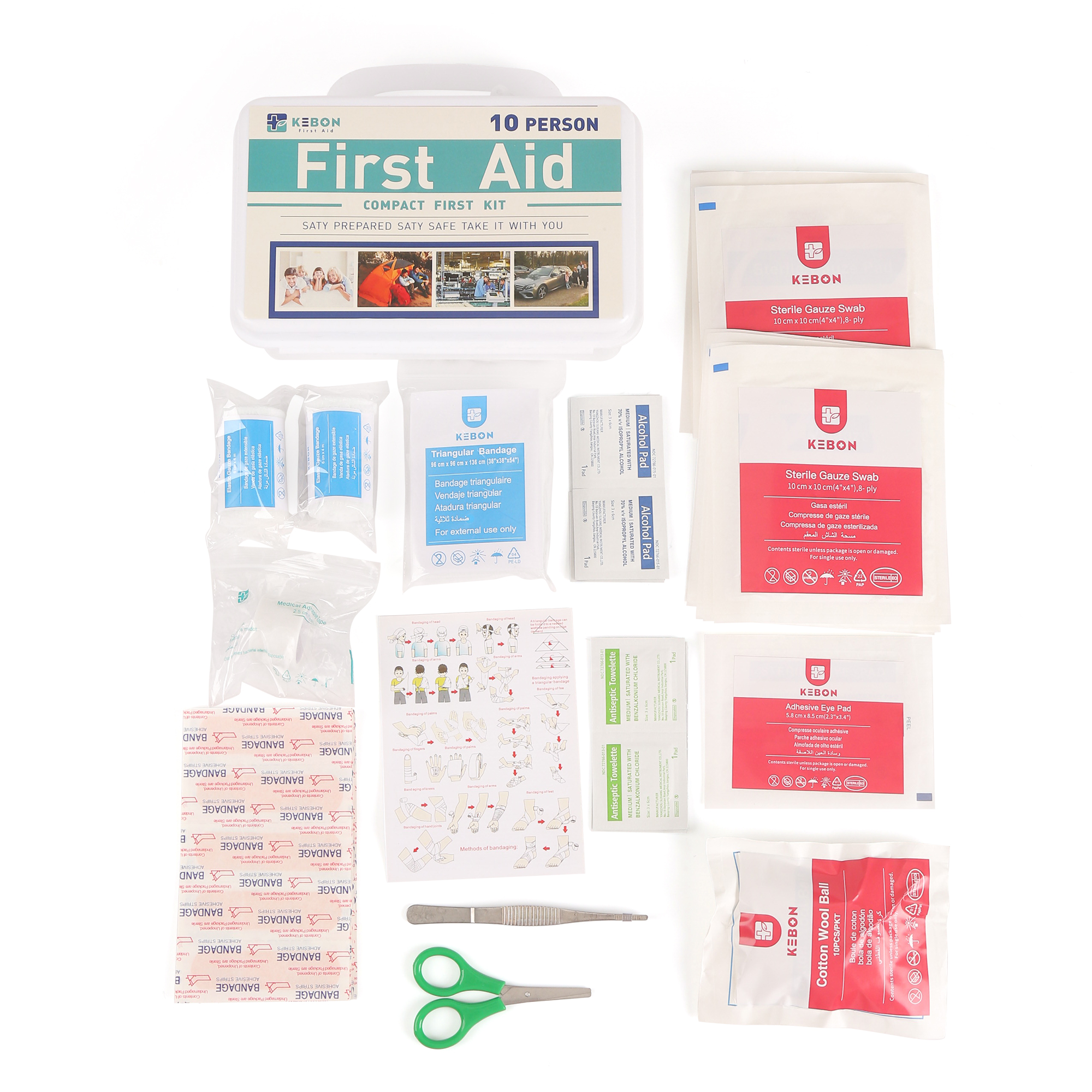 Why "Missing Items" Drive First Aid Kit Returns2026/09/22
"Missing items" and "small size" are the top complaints in online first aid kit reviews. Here is how private label sellers can spec kits that earn 4.8 stars.
 UKCA or CE? UK Medical Device Rules for First Aid Kits2026/09/22
UK medical device rules are shifting again. What CE and UKCA really require for first aid kits in 2026, the 2028/2030 deadlines, and what to do now.