


Call Us
+86-19518020980
Email Us
chloe@kebonfirstaid.com

European Vehicle First Aid Kits: DIN 13164 & BS 8599-2
Ask ten buyers what a European car first aid kit must contain, and you will usually get one confident answer — the answer for the country they sell in. That is exactly the problem. Unlike workplace kits, which at least have a widely referenced benchmark in each market, vehicle first aid kits in Europe are governed by a patchwork of national standards and road traffic laws, and there is no single EU-wide kit specification that satisfies every member state.
For importers, private-label brands and automotive accessory distributors, this patchwork is either a compliance trap or a product-line opportunity, depending on how you spec the kit. We manufacture vehicle and car emergency kits in China for buyers across Europe, and the same questions come up in almost every project. Here is the map we work from.
Why There Is No Single "European Car Kit"
The EU regulates medical devices — the kit's sterile dressings, its classification under the Medical Device Regulation (MDR) — but it does not harmonize what a car kit must contain. That job stays with national road traffic law, and each country wrote its own list at a different time with different priorities.
The practical consequence: a kit that is fully legal in France can fail a roadside check in Germany, and a German-spec DIN 13164 kit does not automatically satisfy Romanian requirements. Distributors who stock one "Europe kit" SKU and ship it everywhere are building on an assumption their customers will eventually test.
What the EU layer does govern is the device side. First aid kits placed on the EU market are medical devices, typically Class I, or Class Is where sterile components are included, and they need CE marking under the MDR with the registration obligations that came into force through 2026. We explain the MDR classification and the changes taking effect in 2027 in a separate article — here, the focus is the national content standards sitting underneath.
Germany: DIN 13164, the De Facto Export Benchmark
Germany requires most passenger vehicles to carry a first aid kit meeting DIN 13164 under its road traffic regulations (StVZO), and the current edition of the standard was published in 2022. Three things matter for buyers:
The contents list is prescriptive. DIN 13164 specifies the exact items and quantities — adhesive dressings, sterile wound dressings, triangular bandages, a resuscitation face mask, gloves, shears, foil blanket and more — packed in the characteristic red case. Substituting items to save cost is not a design decision; it takes the kit out of conformance.
The expiry date is part of the law. German vehicle inspections treat a DIN 13164 kit as compliant only while its sterile contents are in date. A kit whose dressings expired is, for inspection purposes, a missing kit. This is why German-market buyers are unusually sensitive to fresh production dates and why we rotate stock first-expiry-first-out for these programmes.
It has become the export default. Because DIN 13164 is the most recognized and most inspected vehicle kit specification in Europe, many distributors in countries without their own detailed law spec their private-label kits to DIN 13164 anyway. It is the closest thing the continent has to a common denominator — with the caveat below about Austria and others that reference it, and about the countries that do not.
United Kingdom: BS 8599-2 for Motor Vehicles
Post-Brexit, the UK sits outside the EU's device rules, and its vehicle kit benchmark is BS 8599-2 — the British Standard for motor vehicle first aid kits, sitting alongside BS 8599-1 for workplaces, which we covered in detail when its 2026 amendment was published.
BS 8599-2 defines kit sizes — small, medium and large — scaled to passenger count and journey risk, rather than a single fixed list. The standard is not a legal requirement: UK road law does not mandate carrying a first aid kit at all for ordinary cars. But it is what UK fleet operators, driving schools and responsible retailers buy against, and it is the specification UK buyers cite in purchase orders.
For a private-label brand selling into the UK, the choice is between a minimum-cost token kit and a BS 8599-2-conformant range that fleet buyers can specify without a compliance conversation. The second option costs more per unit and sells without explaining itself.
Romania and the Countries With Their Own Lists
Romania illustrates the "own national list" pattern. Under its road traffic emergency ordinance (OUG 195/2002), drivers must carry a first aid kit alongside a warning triangle and fire extinguisher, with contents specified by a Ministry of Health order (623/1999). The Romanian specification requires a rigid container and a defined set of items — bandages, disinfectants, a mouth-to-mouth resuscitation device with a valve, and an isothermal foil — and non-compliance carries fines.
Notice what is different from Germany: the resuscitation device is a valve shield rather than a face mask, the case requirement is stated as rigid rather than as a specific standard case, and the enforcement mechanism is police roadside checks rather than periodic vehicle inspection. These are not cosmetic differences. They change the bill of materials, the packaging artwork, the language requirements and the inspection logic.
Other European markets sit at various points on this spectrum — some reference DIN 13164 or accept it in practice, some keep legacy national lists, and some mandate nothing but reward a quality kit at retail. Mapping each target country before you tool up a SKU is a one-week exercise that prevents a warehouse full of kits that sell in three markets and sit dead in a fourth.
Building a Multi-Market Vehicle Kit Range
The most common structure we build for European distributors is a three-tier range:
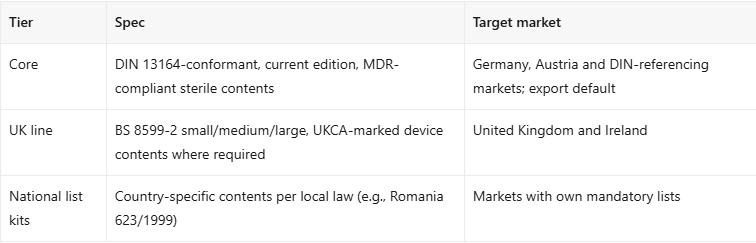 Around that core, one design decision pays for itself repeatedly: a case and insert architecture that is shared across tiers, with content cards and artwork localized per market. The tooling cost is paid once; each new country variant becomes a content and label change instead of a new product development. We run this structure for several European customers — same PP case family, different inner trays, market-specific language and lists.
Two production details matter more than buyers expect:
Sterile component sourcing and MDR documentation. The dressings and shields inside a vehicle kit are medical devices in their own right. For EU markets the kit's CE path, its Class I/Is classification and the component documentation must line up — we covered the classification logic in our MDR article, and it applies identically to car kits and workplace kits.
Date management at volume. Because German-market kits are date-sensitive by law, the production plan needs batch rotation, minimum remaining shelf life commitments and clear date coding. A vehicle kit programme that ignores shelf life produces returns; one that manages it produces reorders.
If you are mapping a vehicle kit range against these standards, we build all three tiers as standard products — including a car emergency rescue kit platform that most of our European vehicle programmes start from. Send us your target countries and volume, and we will propose the tier structure and quote each one.
What Buyers Get Wrong — and How to Avoid It
Four recurring mistakes we see in vehicle kit sourcing projects:
One SKU for all of Europe. Covered above; it fails at the inspection logic, not just the contents list. Fix it with the tier structure.
Treating the standard as the whole compliance picture. A DIN 13164 contents list inside a kit that lacks proper MDR documentation for its sterile contents is not sellable in the EU, whatever the list says. Content standards and device regulation stack.
Ignoring the date economics. Kits with aggressive expiry dates force retailers to discount or destroy stock. Specifying minimum remaining shelf life at dispatch — 18 to 24 months is a common ask — shifts that risk back to the factory, where it belongs.
Designing the case last. The case is the product as far as the consumer is concerned: it must fit the glovebox or the boot, open one-handed on a roadside, and carry market-specific labeling. Buyers who decide the case after the contents list almost always pay for a redesign.
Quick Answers for Buyers
Can one kit be CE marked and UKCA marked at the same time?
The kit's non-sterile case and general assembly aside, what carries the marking is the medical device content and the kit's documentation. EU markets require conformity under the MDR; the UK regime runs on its own rules for devices placed on the GB market. We build market-specific documentation packs per destination rather than trying to make one pack serve both — the cost difference is small, and the inspection risk it removes is not.
What MOQ makes a three-tier range viable?
At our standard MOQ of 5000 units per SKU, a lean range — one DIN tier, one BS 8599-2 size, one national-list variant — starts at 1,500 units total. Many buyers launch with two tiers and add the third in a repeat order once the first sells through. Tier structure is a growth decision, not a day-one requirement.
Do vehicle kits need the same first aid guide as workplace kits?
Not exactly. Roadside use changes the guidance emphasis: what to do at the scene of a traffic incident, how to signal, when to move a casualty. DIN 13164 kits carry their own instruction insert, and market-specific language versions matter more in vehicle kits than most buyers expect, because the person using a car kit is an ordinary driver, not a trained first aider.
How much shelf life should I demand at dispatch?
For German-market DIN 13164 kits, plan around 18–24 months minimum remaining shelf life so the kit survives a retail cycle and still passes inspection in the customer's glovebox. We write the commitment into order confirmations and date-code every batch.
How Kebon Builds Vehicle Kits
We manufacture first aid kits, car emergency kits and tactical bags in Yiwu, China — roughly 100 people across 5,000 square meters, ISO 13485, CE, FDA and UKCA registered, MOQ 500 units per SKU, standard lead time about 30 days. For vehicle programmes specifically, that means:
*DIN 13164 and BS 8599-2 builds as standard configurations, with content traceability per batch
*Market-specific content lists and multilingual labeling, including Romanian and other national-list markets
*Sterile components sourced and documented for the relevant device regime, EU or UK
*Date-coded production with minimum remaining shelf life written into the order confirmation
If your range needs a car kit line that passes roadside logic and retailer onboarding in equal measure, request a quote from our export team — tell us the markets and annual volume, and we will respond with a costed, tiered proposal.
Further Reading
*EU MDR First Aid Kits: Classes, EUDAMED and 2027 Car Rules — the device-regulation layer under every EU kit, vehicle or workplace.
*BS 8599-1:2026: UK First Aid Kit Sizes, Contents and AEDs — the workplace sibling of BS 8599-2, updated for the 2026 amendment.
*GCC First Aid Kit Rules: Saudi Arabia and UAE Compliance — if your vehicle range also ships to Gulf markets.
Questions about vehicle kit specifications? Contact our export team — we reply within one business day.
Send Inquiry




X
We use cookies to offer you a better browsing experience, analyze site traffic and personalize content. By using this site, you agree to our use of cookies.
Privacy Policy
News
 Naloxone in Workplace First Aid Kits: The 2027 US Shift2026/11/10
ANSI Z308.1-2026 recognizes naloxone, OSHA issued new guidance, and New York's rule starts 13 December 2026. What naloxone-ready kits mean for brands.
 European Vehicle First Aid Kits: DIN 13164 & BS 8599-22026/11/10
Car first aid kit rules differ across Europe: DIN 13164 in Germany, BS 8599-2 in the UK, national lists elsewhere. What importers and brands must stock.