


Call Us
+86-19518020980
Email Us
chloe@kebonfirstaid.com

Suez Canal Return: First Aid Kit Freight Outlook 2027
For most of the last three years, shipping a container of first aid kits from China to Europe or the US East Coast has meant one thing: the long way around. Vessels diverted via the Cape of Good Hope, transit times stretched by 10 to 14 days, and freight rates carried a security premium that never fully went away.
That era is ending — not with an announcement, but with a schedule change at a time. Since early November 2026, the majority of container capacity on Asia–Europe trades has quietly returned to the Suez Canal, and the freight market is repricing accordingly. If you import first aid kits, the next six months will reward shippers who read this shift early and penalize those who lock contracts on stale assumptions.
Here is what is actually happening on the water, what it means for 2027 freight budgets, and how to plan orders around it.
The Return to Suez, Week by Week
The numbers tell the story faster than any press release:
*Maersk and Hapag-Lloyd began routing their Gemini cooperation's ME1 service through the Red Sea and Suez Canal in early November. The westbound first sailing, the Atlanta Express, departed Salalah on 4 November; the eastbound Savannah Express follows from Tangier on 13 November.
*Evergreen restarts its China–Red Sea service on 12 November, with the 7,024-TEU Ever Superb sailing from Qingdao — the carrier's first Red Sea transit since January 2024.
*Yang Ming resumes its Asia–Mediterranean MD1 service in December with an 11,714-TEU vessel out of Ningbo.
*MSC has already restored Suez transits on its Europe–Australia express loop.
By the week ending 1 November, 53 container ships transited the Suez Canal — up 130% year on year — after the previous week's 62 transits set a 2026 high. Roughly 3 million TEU passed through the canal in October alone. Around 60% of Asia–Europe container capacity is now sailing via Suez, and diversions around the Cape of Good Hope have fallen to about 180 vessels, the lowest since January 2024 and roughly half the two-year average of 350.
Drewry expects canal transits to recover to about 80% of normal levels by February 2027. Analysts estimate the full return will release around 1.6 million TEU of effective capacity into the market during 2027 — capacity that was previously absorbed by longer voyages, because a ship sailing the Cape completes fewer round trips per year even though the fleet size is unchanged.
What Happens to Rates
The repricing has already started. Maersk's week-46 Shanghai–Rotterdam opening price came in at $3,000 per FEU, the second consecutive weekly cut, down $200 from the week before. Spot indices across major lanes have softened in parallel, and carriers' attempts to push through 1 November freight-all-kinds increases largely failed to stick.
The direction matters more than any single print. With capacity returning and demand seasonally soft — the US National Retail Federation expects November US ocean imports to fall 11% from October as peak-season cargo winds down — analysts project spot rates could fall by as much as 30% through 2027 if the Suez recovery holds.
Carriers are fighting back the only way they can: blank sailings. Ocean Alliance scheduled eight blank sailings on Asia–North Europe in November, and Drewry counts 56 cancellations out of 715 planned sailings on east–west trades over weeks 45–49 — an 8% cancellation rate. Expect carriers to keep removing capacity aggressively through the Chinese New Year period to slow the slide.
Two caveats keep this from being a one-way bet:
Red Sea security remains the single point of failure. The entire rate-down scenario assumes carriers stay in the canal. If security conditions deteriorate, carriers can re-divert within weeks — adding 8–12 days to Asia–Europe transits, pulling 40–50% of effective weekly capacity out of the market, and pushing rates up 25–35% in a stress scenario. Nobody should model 2027 freight budgets on the optimistic case alone.
Middle East and Red Sea port rates behave differently. Direct services to Jebel Ali, Jeddah, and other regional gateways are repricing too, but the fastest rate declines are on the mainline Asia–Europe and transpacific trades.
What This Means for First Aid Kit Buyers
First aid kits are dense, stackable, low-urgency cargo — which means freight is a bigger share of landed cost than for high-value electronics, and timing is the main lever a buyer controls. Three moves are worth making before the Chinese New Year shutdown on 6 February 2027:
1. Treat Q1 as the favorable window. If capacity keeps returning, the cheapest ocean freight of 2027 is most likely available between January and April — after the CNY demand pull-in, before any peak-season restocking. Buyers who can tolerate slightly longer cash cycles should time their restock shipments to ride this window rather than locking contracts sized to 2026 rates.
2. Split your strategy between contract and spot. If you ship containers monthly, negotiate contract rates now while carriers are hungry for Q1 volume — the market momentum is on the buyer's side for the first time in three years. Keep a spot allocation for opportunistic loads. If you ship occasionally, spot is simply your friend through H1 2027, with the caveat that a security shock can flip the market in days.
3. Re-check your Middle East math. For buyers shipping to GCC markets — a growing share of our order book — restored Suez routings shorten transit from China to Gulf ports substantially compared with Cape routings, improving inventory turns for Saudi and UAE distribution. We covered the regulatory side of GCC market entry separately; the freight side just got easier.
If you are planning a 2027 programme and want a factory that builds shipping reality into the production schedule — not just a per-unit price that ignores freight — tell us your destination port and target timeline, and we will put a costed plan in front of you.
The 2027 Calendar, Updated
Our Black Friday restocking guide laid out the sequencing through Chinese New Year; the Suez return changes the freight lines of that calendar. Here is the combined picture as of 9 November 2026:
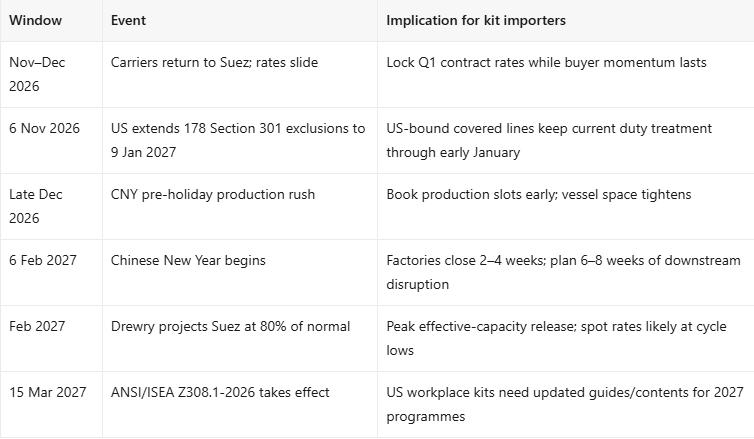
Read together, the calendar says one thing: production in December, shipping in the January–April trough, and a product refresh timed to the ANSI update. Buyers who compress all three into February will pay both the pre-CNY freight rush and post-CNY capacity scramble.
One more supply-chain note: our sister coverage on AI cargo crowding explained how data-center hardware has been absorbing air and ocean capacity on Asia–US lanes. That pressure has not disappeared — it has simply been offset by Suez recovery on the capacity side. If Red Sea security reverses, the two forces stack in the same direction, which is exactly the scenario your 2027 freight contingency should model.
Air Freight, LCL and Small Orders
Not every first aid kit order fills a container, and the Suez story lands differently depending on how you ship.
Full containers (FCL) capture most of the benefit directly. Ocean spot rates per FEU are where the 30% downside projection bites, and a 40-foot load of assembled kits is the most freight-efficient way to move volume. If your programme supports it, consolidating SKUs into full loads on the January–April window is the single largest landed-cost lever available in 2027.
Less-than-container (LCL) buyers should watch a second-order effect: as rates fall, consolidators rebuild their east–west consolidation boxes, and LCL minimums and per-CBM rates usually follow FCL down with a lag of several weeks. If you ship LCL today, re-quote your forwarder's rates in January — many LCL contracts were priced during the Cape-diversion era and have not caught up with the market.
Air freight is where the AI cargo story from our earlier coverage still bites. Data-center hardware, GPUs and server components continue to absorb belly capacity on Asia–US and Asia–Europe lanes, keeping air rates structurally higher than pre-2024 norms. For first aid kits, air freight is rarely justified by urgency — kits are not perishable and rarely launch-window dependent — but there are two exceptions worth knowing: launch quantities for retail listings that cannot miss a season, and replacement stock after a quality issue that cannot wait six weeks. For everything else, plan ocean and let the calendar do the work.
A practical rule we share with new importers: first air-freight quote, then decide. If the air premium on a pallet of kits is less than the margin you would lose from missing your listing window, it is the right call. If it is more, the ocean calendar almost always wins.
A Note on Rate Volatility and Quoting
One caution for brands that quote landed prices to their own customers: a freight assumption embedded in a price list written in November 2026 may be badly wrong by March 2027 — in either direction. The spread between the stress scenario (re-diversion, rates up 25–35%) and the base case (rates down up to 30%) is the widest we have seen since 2021.
Three habits keep quotes honest through this period:
*Date-stamp your freight assumptions. Write the rate and the week you sourced it into your costing sheet, so stale numbers announce themselves.
*Quote in ranges for long-dated orders. If a distributor commits to a Q2 2027 programme, price the freight line as a range with a validity window, not a fixed number that pretends certainty.
*Separate the freight line from the product line. When freight moves, you want to adjust one number, not renegotiate the whole quote. We quote product FOB and let buyers or their forwarders hold the freight line for exactly this reason.
How We Plan Shipping at Kebon
We manufacture first aid kits and tactical bags in Yiwu, Zhejiang — about 100 people across 5,000 square meters, ISO 13485, CE, FDA and UKCA registered, with a standard 30-day lead time and an MOQ of 500 units per SKU. Ningbo port is under two hours from our floor, which gives us realistic control over vessel cut-offs instead of guesses.
When we quote a programme, we quote it against a shipping calendar: production slot, inland transit, cut-off, sail date, and — for tariff-sensitive US cargo — the expected customs entry date. We also flag when a buyer's schedule collides with a known disruption window, because a cheap per-unit price that ships into a 40-day delay is not cheap.
If your 2027 range needs a production partner who plans around the freight cycle instead of pretending it does not exist, request a quote with your destination market and target ship date. We will show you the calendar we would run your order on — before you commit.
Freight markets are finally moving in buyers' favor. The advantage goes to importers who plan around it deliberately.
Further Reading
*Why AI Cargo Is Pushing Up First Aid Kit Freight Costs — the other half of the 2027 capacity story, and what it means for Asia–US lanes.
*Restocking First Aid Kits After Black Friday: 90-Day Plan — the full CNY restocking calendar this article updates.
*After 9 November: New Landed Costs for First Aid Kits — how duty scenarios stack on top of freight timing for US-bound kits.
Questions about shipping schedules or production slots? Contact our export team — we reply within one business day.
Send Inquiry




X
We use cookies to offer you a better browsing experience, analyze site traffic and personalize content. By using this site, you agree to our use of cookies.
Privacy Policy
News
 Naloxone in Workplace First Aid Kits: The 2027 US Shift2026/11/10
ANSI Z308.1-2026 recognizes naloxone, OSHA issued new guidance, and New York's rule starts 13 December 2026. What naloxone-ready kits mean for brands.
 European Vehicle First Aid Kits: DIN 13164 & BS 8599-22026/11/10
Car first aid kit rules differ across Europe: DIN 13164 in Germany, BS 8599-2 in the UK, national lists elsewhere. What importers and brands must stock.