


Call Us
+86-19518020980
Email Us
chloe@kebonfirstaid.com

Naloxone in Workplace First Aid Kits: The 2027 US Shift
Three separate developments in 2026 are pushing the same item — naloxone, the opioid overdose reversal medication — toward the American workplace first aid kit. None of them is a mandate covering every employer, but together they are changing what US buyers expect a workplace kit to be, and what brands should be building into their 2027 ranges.
For importers and private-label brands, this is one of the clearer product opportunities of the coming cycle: a defined content shift, an effective date, and a buyer base already being told by regulators to prepare. Here is what is happening, and how a factory like ours fits into it.
The Three Signals
ANSI/ISEA Z308.1-2026 names naloxone. The updated US workplace first aid kit standard, which takes effect on 15 March 2027, expands its guidance on supplemental supplies to include naloxone for opioid emergency response and anti-choking devices. To be precise about what that means: naloxone sits in the expanded supplemental guidance, outside the minimum contents that define Class A and Class B kits. A conformant Class A kit does not have to contain naloxone. But the standard now gives employers a recognized framework for adding it — and gives buyers a specification to reference when they ask their suppliers for a naloxone-capable configuration.
OSHA issued its own guidance. On 24 September 2026, the Occupational Safety and Health Administration released a fact sheet, "Opioid Overdose Rescue with Reversal Medications," as part of the federal government's overdose response initiative. It is guidance, not a new rule — OSHA explicitly did not create new requirements under its medical services and first aid provisions. What it does is describe what a prepared workplace looks like: keep FDA-approved reversal medication such as naloxone or nalmefene on site, store it visibly and accessibly the way AEDs and first aid kits are stored, train designated responders, write a policy, and call 911 first in an emergency. Employers in state-plan states should also check whether local law adds obligations.
New York's deadline is weeks away. New York's workplace naloxone requirement takes effect on 13 December 2026, and we covered its specifics separately. For brands selling workplace kits into New York, the question has already moved from "whether" to "which configuration."
Around these three, context: the National Safety Council reports that drug overdose causes about 8% of workplace deaths, while only 28% of employers say they currently keep naloxone at their worksites. A bipartisan bill — the Workplace Overdose Reversal Kits (WORK) to Save Lives Act — is pending in Congress to expand workplace access nationwide. The gap between 8% risk and 28% preparedness is the commercial space this article is about.
What a "Naloxone-Ready" Kit Actually Is
Start with the compliance boundary, because it shapes everything: naloxone is an FDA-regulated drug. A first aid kit manufacturer in China does not supply it, ship it, or include it in exported kits. What a manufacturer can do — and what the 2027 market increasingly asks for — is build the kit so that adding naloxone is a clean, documented, one-step process for the buyer in the US.
In practice, naloxone-ready means several things on the factory side:
Dedicated, labeled storage. A marked compartment or pouch sized for standard naloxone nasal spray configurations, positioned for the visibility OSHA's guidance describes — not buried under gauze. Employers are told to place reversal medication where AEDs and first aid kits live; the kit's interior should make that placement obvious.
Updated first aid guidance. ANSI/ISEA Z308.1-2026 requires bilingual English–Spanish first aid guides, and the 2026 edition's guidance framework assumes employers may include supplemental items. A naloxone-ready kit's guide should have a page that covers recognizing an overdose, calling 911 first, administering the spray, and staying with the person — aligned with OSHA's fact sheet language rather than improvised.
Configuration documentation. If a buyer will add naloxone downstream, the kit's conformity claim has to survive the modification. That means documenting which configurations are ANSI-conformant as shipped, and how the supplemental naloxone pocket relates to the standard's guidance. Sloppy claims here are how brands end up with a listing that says "ANSI kit with naloxone" and no evidence behind either half.
The rest of the 2026 update, not just naloxone. The same standard clarifies arterial tourniquet performance requirements, adds mobile-worker kit guidance, and strengthens workplace hazard assessment content. A 2027 workplace range updated only for naloxone misses the rest of what buyers will be checking against.
We build workplace kits against ANSI configurations for US programmes and DIN/MDR configurations for European ones — including our workplace kit platforms that carry both sets of documentation. If you are planning a 2027 US workplace range, send us the configuration you have in mind and we will quote it with the naloxone-ready features built in from the sample stage, not retrofitted after.
Sizing the Opportunity
Three buyer segments drive near-term demand, each for a different reason:
Regulated and semi-regulated employers. New York employers covered by the December 2026 rule need compliant setups now. Employers in other states are watching OSHA's guidance and their own state legislatures. These buyers purchase through distributors, and distributors spec what is easiest to explain — a kit designed for the job beats a standard kit plus an aftermarket pouch.
High-traffic and public-facing workplaces. Restaurants, bars, warehouses, construction sites, gyms and retail with public restrooms are the segments workplace-safety advisors flag as highest priority. Their purchases skew toward durable wall-mountable cases and refillable configurations — which conveniently matches the industrial kit formats factories like ours already run at volume.
Fleet and mobile workforces. ANSI/ISEA Z308.1-2026 adds specific guidance for kits serving mobile workers — location, contents, storage, inspection. Logistics fleets, field services and rideshare-adjacent operators translate that into compact vehicle kits, which ties into the vehicle kit line we covered separately for Europe.
The pattern across all three: nobody is buying "a naloxone." They are buying a programme — kit, storage, guide, training materials — and the kit is the anchor SKU. Brands that show up with a coherent, documented configuration win the programme; brands that show up with a stock kit and a suggestion lose the order to someone who did the design work.
What to Ask Your Factory Before You Spec It
If you bring this opportunity to a supplier — whether that is us or someone else — five questions separate a real naloxone-ready programme from a marketing sticker:
1. Can you show the ANSI/ISEA Z308.1-2026 configuration in physical form, not just on paper? Ask for a sample with the new bilingual guide, the tourniquet spec update and the naloxone pocket built in. Samples reveal whether the supplier has actually re-tooled for the 2026 edition or is relabeling 2021 builds.
2. How is the naloxone compartment documented? The pocket or pouch should appear on the kit's parts list and packing specification, with sizing notes matched to standard nasal spray formats — so your team can verify compatibility when you source the medication stateside.
3. What does your guide's overdose page say, and against which source? It should track OSHA's September 2026 fact sheet sequence — recognize, call 911 first, administer, stay — in English and Spanish, with a version date printed on the page. An undated, unversioned insert is a recall waiting to happen.
4. How do you protect the conformity claim when the buyer adds the drug downstream? The factory should state in writing which configurations conform as shipped and that the supplemental naloxone pocket is designed around the standard's guidance — so your product page claim has a paper trail.
5. What are your date and batch controls on the guide and components? Guides, sterile contents and dates should be batch-traceable, because a corrected guide needs a documented replacement path through your distribution — exactly the component-traceability discipline we wrote about in our recalls article.
Suppliers who answer all five without homework are ready for this programme. Suppliers who improvise answers are selling you a 2021 kit with a 2026 sticker.
The Compliance Landscape, Stated Carefully
Because this topic touches drugs, devices and employment law, precision matters more than usual:
*Naloxone and nalmefene are FDA-approved reversal medications. The OSHA fact sheet describes them as such. Since 2023, a naloxone nasal spray has also been available over the counter in the US, which is what makes employer-purchased programmes practical.
*OSHA's guidance creates no new legal duty. Law firm analyses of the fact sheet are consistent: it is a recommendation, with state-plan states free to add requirements. But guidance shapes what "prepared" looks like after an incident, which is why safety managers treat it seriously anyway.
*ANSI/ISEA Z308.1-2026 is voluntary — referenced, not mandated. OSHA's nonmandatory appendix points to ANSI Z308.1 as an example of adequate supplies, and the 2026 edition takes effect 15 March 2027. Voluntary standards still function as purchase specifications; "conforms to ANSI/ISEA Z308.1-2026" is a claim buyers increasingly verify.
*Kit makers do not handle the drug. Our role ends at the pouch, the guide, the documentation and the assembly. Naloxone procurement, storage conditions and training happen on the employer side, under US law. We say this plainly in quotations, and so should any brand describing these kits to its customers.
If you want a factory that draws this line cleanly — building everything on the hardware side while staying out of the drug supply chain — request a quote with your target configuration and market, and we will respond with a sample plan.
Timing: Why Q4 2026 Is the Design Window
Stack the dates and a production calendar falls out:
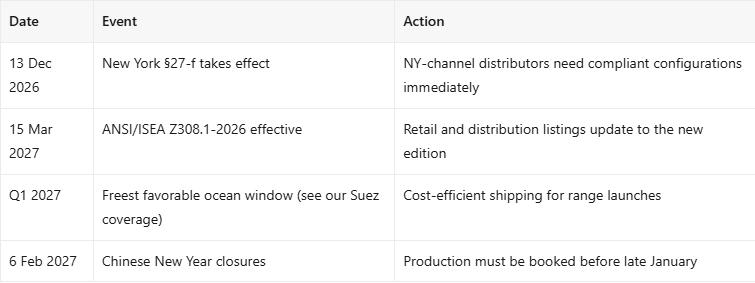
That sequence says: finalize naloxone-ready configurations in the next 8–10 weeks, produce in December–January, and land in the Q1 freight trough with a range that answers the standard's effective date. Buyers who start this conversation in February 2027 will be quoting against post-CNY lead times and mid-cycle freight — workable, just more expensive.
Our standard terms apply: MOQ 500 units per SKU, about 30 days' lead time, ISO 13485, CE, FDA and UKCA registrations, roughly 100 people across 5,000 square meters in Yiwu. For a configuration conversation, contact our export team or send the inquiry directly — include your distribution channel and target states, and we will propose a range that fits.
The naloxone shift is not a fad product; it is a standards-cycle event with dates attached. Standards-cycle events are exactly when private-label brands gain or lose shelf position for the next three years.
Further Reading
*NY Workplace Naloxone Rule: What Changes on 13 December 2026 — the state rule with the nearest deadline.
*ANSI/ISEA Z308.1-2026 Published: What Importers Must Change — the full 2026 update: guides, tourniquets, mobile workers.
*California First Aid Rules 2027: What Changes for Kits — the other major US state shift for 2027 workplace kits.
Send Inquiry


X
We use cookies to offer you a better browsing experience, analyze site traffic and personalize content. By using this site, you agree to our use of cookies.
Privacy Policy
News
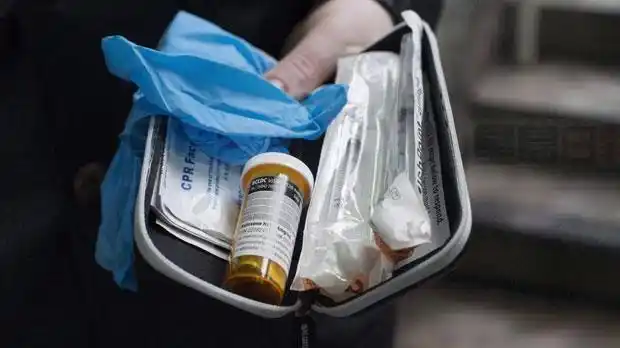 Naloxone in Workplace First Aid Kits: The 2027 US Shift2026/11/10
ANSI Z308.1-2026 recognizes naloxone, OSHA issued new guidance, and New York's rule starts 13 December 2026. What naloxone-ready kits mean for brands.
 European Vehicle First Aid Kits: DIN 13164 & BS 8599-22026/11/10
Car first aid kit rules differ across Europe: DIN 13164 in Germany, BS 8599-2 in the UK, national lists elsewhere. What importers and brands must stock.