


Call Us
+86-19518020980
Email Us
chloe@kebonfirstaid.com

NY Workplace Naloxone Rule: What Changes on 13 December 2026
On 13 December 2026, New York State will require most private employers to keep opioid antagonists — naloxone, or the brand-name products most people know as Narcan — available in the workplace. The law has been in the works for a year, but September brought the piece that turns it from a principle into an operational requirement: the implementing rules.
For suppliers of workplace first aid kits, this is one of the more consequential American regulatory moments of the year. Not because it creates a large new product category — naloxone itself is a pharmaceutical, not a first aid consumable — but because it forces a redesign question that most existing kit layouts cannot answer cleanly.
Here is what the law requires, what the proposed rules say, and where kit design runs into trouble.
1. What the law says, and who is covered
New York Labor Law §27-f was signed into law on 12 December 2025. Amendments signed on 13 February 2026 clarified the employer scope and the exemptions, and moved the effective date to 13 December 2026.
The coverage test is not "all employers." It is anchored to federal OSHA rules:
Covered: private employers that are federally required to keep first aid supplies on hand.
Excluded: government employers.
In practice, the OSHA provision in question is 29 CFR 1910.151, which requires adequate first aid supplies to be readily available, and requires trained first aid personnel when an infirmary, clinic or hospital treating injured employees is not nearby. Where that condition applies, the §27-f obligation attaches.
That "not nearby" wording is doing a lot of work, and it is worth understanding, because it determines whether a given site is covered at all.
2. The trigger: the three-to-four minute test
The regulations do not define "near proximity." OSHA does, in effect — and it has said so consistently for nearly two decades.
A 2007 OSHA interpretation letter states that the agency has long interpreted "near proximity" to mean that emergency care must be available within no more than three to four minutes from the workplace.
That is a tight window. Three to four minutes is roughly the time it takes to move a person to a vehicle, drive a short distance, and hand over care — or, in a dense urban setting, the time for an on-site response team to reach a casualty and begin treatment while an ambulance is dispatched. For a warehouse on the edge of a rural county, it is generally not achievable. For an office building two blocks from a hospital emergency department, it usually is.
The practical consequence: a multi-site employer may have some covered sites and some uncovered sites, and the determination turns on a measurement rather than a policy preference. Employers who have never mapped response times to their facilities will need to do so.
3. What the proposed rules would require
NYSDOL published its proposed implementing rules on 23 September 2026. They remain proposed as of 9 October 2026, with the comment period running to 22 November 2026. What follows is the draft as published.
Quantity: "sufficient," by assessment — not a fixed number.
The rules do not prescribe a specific count. Employers must maintain a sufficient number of opioid antagonists based on:
*Worksite size and layout
*Staffing levels
*Whether high-risk populations access the site
*The nature of the work
*Any history of on-site overdoses
For suppliers used to specifying kits by headcount tables, this is a different discipline. The answer is not a lookup; it is an argument, and it has to be documented.
Placement: reachable, visible, and not behind three doors.
Supplies must be stored in easily accessible locations. Employees should not have to travel through multiple doorways or stairways to reach them. The rules steer employers toward keeping supplies near AEDs and other first aid kits, in a central, visible location.
Locked rooms are discouraged — unless security requirements make locking necessary, and provided quick access is still assured. Supply locations must be communicated to all employees.
That last requirement is easy to underestimate. A kit in the right place that nobody knows about fails the test as surely as a kit in the wrong place.
Packaging: sealed, in manufacturer packaging, with instructions.
Medication must remain sealed in the manufacturer's original packaging with the manufacturer's instructions. Where original instructions are absent, instructions from the New York State Department of Health, the New York City Department of Health and Mental Hygiene, or the New York State Drug User Health Training Center of Expertise may be used.
The antagonist must be FDA-approved. The FDA publishes expiration dates and storage requirements, which employers are expected to follow.
4. Training, and the "one trained employee" rule
Training under the proposed rules must cover:
*Recognising overdose symptoms
*Administering opioid antagonists
*The steps to take before and after administration
*Contacting emergency responders
*Good Samaritan protections
At least one trained employee must be present during business hours. Employers are encouraged to train additional volunteers, or the entire workforce.
That requirement has an operational shape that is easy to miss: it is a coverage obligation, not a capacity obligation. A site with one trained employee on the day shift and none on nights does not satisfy it during night operations. Shift patterns matter.
5. Maintenance, and shared workplaces
Employers must regularly inspect supplies to confirm they have not expired, been tampered with, or gone missing, and must promptly replace and dispose of any dose that is expired, used, missing or compromised.
Notably, the rules do not prescribe an inspection frequency or a disposal method. In practice that means the obligation is a process requirement — the employer has to be able to show that inspections happen and that someone owns them.
Shared workplaces may comply jointly through a written plan, which must be provided to NYSDOL on request. For business parks, co-working sites, and multi-tenant industrial buildings, this is a useful provision: it turns a per-tenant obligation into a building-level one, provided it is documented.
Cost is expected to be modest. Naloxone is often available at little or no cost through public health programmes, and free training is widely available through the Office of Addiction Services and Supports and other state and city channels.
6. OSHA's federal guidance is not a federal mandate
On 24 September 2026 — one day after NYSDOL published its proposed rules — OSHA released a fact sheet, Opioid Overdose Rescue with Reversal Medications.
It is worth being precise about what this is and is not.
It is not a new federal requirement. OSHA's existing first aid standard, 29 CFR 1910.151, is unchanged. The fact sheet provides a framework for employers who want to add overdose response to their first aid programmes, and recommends that all employers — not only New York employers subject to §27-f — maintain opioid antagonists, monitor inventory, and train employees.
It identifies naloxone (commonly known by the brand name Narcan) and nalmefene as FDA-approved overdose reversal medications, and sets out practical guidance: place supplies in clearly identified, accessible locations such as near first aid kits and AEDs; follow storage instructions including protection from direct light and excessive heat; assign someone to monitor expiration dates; and consider multiple locations in larger facilities.
The training content OSHA describes is consistent with the New York rules: recognising symptoms, administration, the possible need for additional doses, safe positioning, and Good Samaritan protections. Warning signs it lists include unresponsiveness, slow or stopped breathing, blue lips, and pinpoint pupils.
One point OSHA makes explicitly, and which belongs on any label or training card: reversal medications do not replace emergency medical care. Call 911 immediately, even if the person regains consciousness.
The commercial reading: New York has created a legal obligation, and OSHA has published national guidance that recommends the same practice everywhere. Suppliers should expect demand well outside New York — from employers who read the federal guidance and decide not to wait for their own state to legislate.
7. Why this is a first aid kit problem
Here is where this stops being a pharmaceutical question and becomes a product design question.
The New York rules require accessible placement, identification, and communication of location. The natural home for an opioid antagonist in a workplace is with the first aid kit or beside the AED — because that is where people already expect to look in an emergency, and because OSHA's guidance points there too.
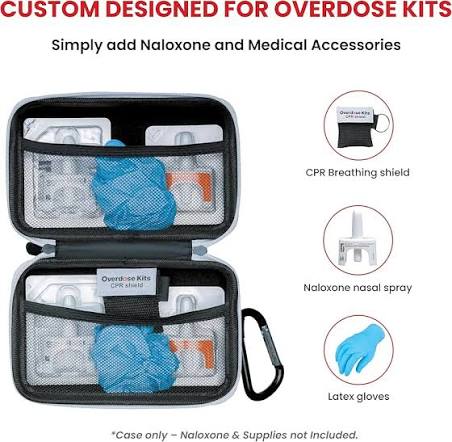
But most first aid kits on the market were not designed for it. A nasal spray is a bulky, crushable, boxed item. A rigid kit with moulded cavities and no spare volume cannot accommodate it without either crushing the device or removing something else. And a kit with no labelled compartment turns "accessible and identified" into a hunt.
Four design consequences follow:
Container volume. The kit needs usable space for a boxed nasal spray, not just a theoretical void. A layout that accommodates one without compressing it is a different build from a standard Class A configuration.
A labelled compartment. The requirement assumes the antagonist is identifiable and reachable. A dedicated, labelled compartment is the simplest way to satisfy both the rules and the person searching at 2 a.m.
The contents list and artwork must match. If the item is added but the printed list is not updated, the kit now fails its own documentation — and creates exactly the kind of "missing item" complaint that damages retail ratings.
The safety data sheet and instructions sit with the medication. Because the rules require the manufacturer's instructions to remain with the product, the kit has to hold them without them being lost. A pocket or sleeve solves this; a loose box does not.
This is the same direction of travel as the broader American standard update. The ANSI/ISEA Z308.1-2026 revision, published on 17 September 2026, added naloxone to the recommended contents, introduced guidance on CPR and AED readiness, and expanded provisions for mobile and field workers. Two separate documents, moving the same way.
Building US-bound kits that need to accommodate an opioid antagonist? Send us your target configuration and we will come back with a case and insert layout that holds the device, the instructions and a labelled compartment without compromising the rest of the contents.
8. What to do now
If you are a covered New York employer: determine which sites meet the "near proximity" test, decide the quantity by assessment and document the reasoning, choose locations near AEDs and first aid kits, communicate those locations to every employee, and confirm trained-employee coverage across every operating shift — not just the day shift.
If you sell into New York: the specification conversation is available now. Employers who have not done this work will need help with placement logic, kit layout and documentation. That is a service opportunity, not just a product one.
If you sell into the wider United States: OSHA's September guidance recommends the same practice nationally. The employers most likely to act on it are the ones with formal safety functions — the same buyers who track standards.
If you are a supplier: decide your position on the compartment. A kit that cannot hold an opioid antagonist without crushing it is, in a growing number of American specifications, a kit that has to be reworked.
And one boundary worth stating plainly: naloxone is a regulated medicine, and the route by which your buyer may lawfully distribute it varies by state. That determination belongs to the buyer's compliance team. Our role is the case, the compartment and the labelling — the physical product that makes their programme workable.
9. Frequently asked questions
When does the New York requirement take effect?
13 December 2026. The implementing rules published on 23 September 2026 remain proposed, with comments due by 22 November 2026.
Which employers are covered?
Private employers that are federally required to maintain first aid supplies — generally those whose worksites are not within three to four minutes of an infirmary, clinic or hospital. Government employers are excluded.
How many doses must an employer stock?
The proposed rules require a "sufficient number" determined by assessment of worksite size and layout, staffing, whether high-risk populations access the site, the nature of the work, and any history of on-site overdoses. No fixed number is set.
Where should supplies be kept?
In easily accessible locations, ideally near AEDs and other first aid kits in a central, visible place. Locations must be communicated to all employees. Locked storage is discouraged unless security requires it.
Do employees need training?
Yes. At least one trained employee must be present during business hours, and training must cover symptom recognition, administration, pre- and post-administration steps, contacting emergency responders, and Good Samaritan protections.
Does this apply to a shared building?
Employers sharing a worksite may comply jointly through a written plan, which must be provided to NYSDOL on request.
Do first aid kits have to include naloxone?
The New York law requires opioid antagonists to be available in the workplace; it does not expressly require them inside every individual first aid kit. In practice, storing them with the kit or the AED is the arrangement the proposed rules point toward. Separately, ANSI/ISEA Z308.1-2026 now includes naloxone among recommended contents.
Is the OSHA fact sheet a new federal requirement?
No. It is guidance. 29 CFR 1910.151 is unchanged, and the fact sheet recommends — but does not mandate — that employers maintain and train for opioid antagonists.
The short version
New York has moved from principle to operations, with a hard date of 13 December 2026 and a set of proposed rules that turn the requirement into a placement, training and documentation exercise. OSHA has published national guidance pointing the same way.
The kit manufacturers who benefit from this are not the ones who add a line to a price list. They are the ones whose containers can hold the device, whose compartments are labelled, and whose contents lists match what is actually in the box.
That is a design decision, and it is best made before the order, not after.
Send Inquiry




X
We use cookies to offer you a better browsing experience, analyze site traffic and personalize content. By using this site, you agree to our use of cookies.
Privacy Policy
News
 NY Workplace Naloxone Rule: What Changes on 13 December 20262026/10/19
New York's workplace naloxone requirement takes effect 13 December 2026. What the proposed rules require, who is covered, and what to do now.
 Canada Federal First Aid Kit Rules: CSA Z1220 Proposal2026/10/19
anada proposes replacing federal first aid kit content lists with CSA Z1220 across five OHS regulations, covering 20,738 workplaces. Comment deadline: 2 November 2026.