


Call Us
+86-19518020980
Email Us
chloe@kebonfirstaid.com

Canada Federal First Aid Kit Rules: CSA Z1220 Proposal
On 3 October 2026, the Government of Canada published proposed regulations that would change how every federally regulated workplace in the country buys first aid kits. The mechanics of the change sound dry — a substitution of legal text — but the commercial consequences are not. It is, in effect, Canada moving from a fixed shopping list to a living standard.
This is the second significant Canadian development in two years. In 2024, CSA Z1220 itself was updated, tightening what has to be inside workplace kits — most notably making a windlass tourniquet mandatory in Type 2 and Type 3 kits. We covered that change here. The proposal now on the table affects a different layer: the federal regulations themselves.
Here is what was published, why it matters beyond the paperwork, and what importers and brands should think about before the comment period closes on 2 November 2026.
1. What was actually published
The notice, Regulations Amending Certain Regulations Made Under the Canada Labour Code (First Aid Kits), was published in the Canada Gazette, Part I, Volume 160, Number 40, on 3 October 2026.
Its core action is straightforward: it replaces the existing lists of required first aid kit contents in five federal occupational health and safety regulations with an incorporation by reference of CSA Standard Z1220. The five regulations are:
*Canada Occupational Health and Safety Regulations (COHSR)
*On Board Trains Occupational Health and Safety Regulations (OTOHSR)
*Oil and Gas Occupational Safety and Health Regulations (OGOSHR)
*Maritime Occupational Health and Safety Regulations (MOHSR)
*Aviation Occupational Health and Safety Regulations (AOHSR)
Alongside that, the proposal:
*Requires employers to use a workplace first aid risk assessment to select the appropriate kit type under the Standard — Type 1 (personal), Type 2 (basic) or Type 3 (intermediate) — and to size the kit according to the number of workers per shift
*Repeals the old schedules and tables that currently spell out kit contents item by item
*Updates the Administrative Monetary Penalties (Canada Labour Code) Regulations so the Labour Program can enforce the new requirements
*Provides a one-year transition period after the regulations come into force, during which employers may continue using existing kits
Comments are invited within 30 days of publication — by 2 November 2026.
2. Why "incorporation by reference" is the real story
If you skim the notice, the phrase that deserves the most attention is a technical one: ambulatory incorporation by reference.
Under a static incorporation, a regulation adopts a standard as it existed on a given date. The standard can be revised ten times and the regulation still points at the original version until Parliament amends it again.
Under an ambulatory incorporation, the regulation adopts the standard as amended from time to time. When CSA updates Z1220, the update flows automatically into federal law. No new regulatory amendment is required.
Read that against the 2024 revision of Z1220 — which added mandatory windlass tourniquets, upgraded the disinfectant specification, and changed kit contents across the board — and the implication is clear. Canada is not just aligning its rules with the current standard. It is wiring future revisions directly into law.
For suppliers, this changes the nature of the compliance question. The old model rewarded a supplier who could match a published list. The new model requires a supplier who tracks the standard as a living document, and who can re-specify a kit when the next revision lands. Buyers in the Canadian market will increasingly be buying from suppliers who can demonstrate that discipline.
3. From A/B/C/D to Type 1/2/3
The proposal is not only a change of legal technique. It also changes the vocabulary and the logic of kit selection.
Today, the federal COHSR sets out four kit types labelled A, B, C and D. Which one applies depends on the number of employees at the workplace, how remote the workplace is, and what level of first aid certificate the attendant holds. The Aviation Occupational Health and Safety Regulations have their own two types, A and B, with similar content.
After the change, the framework becomes the CSA Z1220 structure:
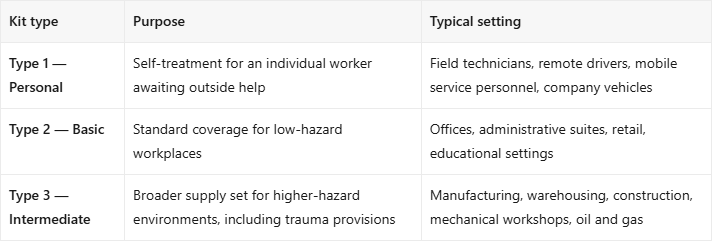
The selection logic also shifts. Under the proposal, kit type and size follow from a risk assessment — the nature of the hazards, the number of workers per shift, and access to medical care — rather than from a lookup table tied to headcount alone.
Two consequences are worth flagging for anyone selling into Canada:
The old terminology becomes a liability. Searches for "Level 2 first aid kit" or "kit A/B/C/D" still circulate widely. Suppliers who can only answer in the old vocabulary will increasingly be talking past specification teams who have moved to Type language.
Type 3 becomes a trauma conversation. Because Type 3 is where the substantive trauma provisions live, the change pushes more Canadian buyers into specifying tourniquets, heavy-duty pressure dressings and advanced wound closure supplies. That is a product-line signal, not a clerical one — and it aligns with what we are seeing in the United States under ANSI/ISEA Z308.1-2026.
4. Who is in scope
The proposal covers employers and workplaces under the Canada Labour Code — that is, federally regulated sectors. That includes:
*Air, rail and road transport
*Marine transportation and ports
*Pipelines and grain handling
*Banks and many federal Crown corporations
*Postal and courier services
*Certain mines and resource operations
*First Nations band councils and other federally regulated workplaces
The government estimates approximately 20,738 workplaces in scope, of which about 18,188 are small employers that are federally regulated. Estimated incremental cost is around CAD 4.8 million in present value over ten years — roughly CAD 685,000 annualised — with an average incremental cost per small business of about CAD 155 presented on the same basis. Many employers already meet the Standard, so actual impact will vary widely.
To put the numbers in context: Canada's federally regulated universe is small in headcount terms but disproportionately influential in specification terms. Transport, logistics, energy and banking employers tend to run formal procurement, formal compliance functions, and national contracts with distributors who also serve provincially regulated customers. When federal rules move, the specifications those buyers issue tend to move with them — and those specifications propagate.
5. Why the harmonisation matters more than the deadline
The proposal is the last piece of a long convergence.
In 2017, the Canadian Free Trade Agreement established a Regulatory Reconciliation and Cooperation Table to reduce barriers to interprovincial trade. The Table tasked the Canadian Association of Administrators of Labour Legislation — Occupational Health and Safety committee with harmonising OHS regulations across jurisdictions. In 2019, all 14 provincial, territorial and federal governments signed an agreement committing each to incorporate CSA Standard Z1220 by reference into their OHS regulations.
Every province and territory has since done so. The federal government is the final party to complete the process.
That is the strategic point for importers. Canada is not producing a patchwork of new rules; it is closing the last gap in a single, nationally consistent kit framework — one that is tied to a living standard and updated on the standard's schedule rather than the legislature's.
For a distributor selling into Canada, the practical benefit is real: a properly specified Type 2 or Type 3 kit increasingly travels across provincial and federal boundaries without rework. For a supplier, the bar rises, because the specification is now the same for everyone and there is nowhere to hide behind a jurisdictional difference.
Selling into Canadian workplaces and not sure your current kits still specify correctly? Send us your SKU list and target provinces and we will map each kit to the Type classification and flag where the 2024 standard changes affect the configuration.
6. What the proposal does not do
It is worth being precise, because this is a week for premature announcements.
It does not take effect on 3 October 2026. The notice is a proposal published for comment. Regulatory approval, final publication and coming-into-force timing are all still ahead.
It does not change the one-year transition idea into a current right. The one-year period runs from coming into force, not from publication.
It does not do away with risk assessment. Employers were already expected to assess their first aid needs. The proposal formalises the use of that assessment as the mechanism for choosing kit type and size.
And it does not replace provincial regulation for provincially regulated employers. Most Canadian workplaces fall under provincial jurisdiction. Because every province and territory has already incorporated CSA Z1220, the practical effect for a national distributor is convergence rather than change — but the enforcement channel differs.
7. What to do before 2 November
If you sell in Canada: read the notice, and consider whether to comment. This is one of the few moments where the specification framework is genuinely open to input, and industry submissions on kit-type definitions, transition mechanics and content specifics do get read.
If you distribute or brand in Canada: start the product-mapping work now. Take your catalogue and classify each kit against Type 1/2/3 logic, then check the 2024 standard's content changes — windlass tourniquets, disinfectant specification, Type 1 provisions, Type 3 Large quantities — against what is actually in the box. The one-year transition is generous; the specification conversations with your customers will start earlier than that.
If you buy from a supplier: ask them directly whether they track CSA Z1220 in its current revision, and whether they can re-specify a kit when the standard changes. Under ambulatory incorporation, that capability is the whole ball game.
8. How Kebon supports Canadian programmes
Our position in this market comes from the same discipline the new framework rewards — treating the standard as a living specification rather than a fixed list.
In practice:
*Component-level content lists supplied in a format that maps to Type 1/2/3 classification, so a buyer's risk assessment can be translated into a build sheet without guesswork
*The 2024 standard's requirements built into quoting, including windlass tourniquet specification in Type 2 and Type 3 configurations and 70% alcohol wipe requirements
*ISO 13485 quality management documentation and batch-level traceability for the ranges we supply
*OEM and private label capability where a distributor or brand needs its own kit identity to a given Type specification
*A broad matrix across the categories Canadian buyers assemble programmes from: workplace medical first aid kits, industrial first aid kits, advanced wound closure kits, car emergency rescue kits and medical consumables for the refill programmes that follow every standard-driven replacement cycle
Where a requested configuration would change the classification of an assembled kit in another market, we flag it at quotation stage. The same discipline applies on this side of the Atlantic, and increasingly it matters in both directions.
Planning a Canadian range refresh ahead of the new federal rules? Tell us which types you need and for which provinces and we will come back with a specification mapping and a realistic production date.
9. Frequently asked questions
Is the federal CSA Z1220 rule in force?
No. It was proposed on 3 October 2026 and is open for comment until 2 November 2026. Final publication and coming-into-force timing have not been announced.
What is "ambulatory incorporation by reference"?
A legal technique in which a regulation adopts a standard as amended from time to time, rather than as it stood on a fixed date. Future CSA Z1220 revisions would flow into federal law automatically.
Does this affect provincially regulated workplaces?
Most Canadian workplaces are provincially regulated and are governed by their own OHS regulations. Those jurisdictions have already incorporated CSA Z1220, so the practical effect is harmonisation rather than a new obligation.
Which kit types exist under CSA Z1220?
Type 1 (personal), Type 2 (basic) and Type 3 (intermediate). Under the proposal, employers select the type and size using a workplace risk assessment and worker numbers per shift.
What changed in CSA Z1220 in 2024?
The most commercially significant change was making a windlass tourniquet mandatory in Type 2 and Type 3 kits, alongside upgrades to disinfectant specification and adjustments to contents across the range.
Does the change mean employers must replace all their kits immediately?
No. The proposal includes a one-year transition period after coming into force. Employers already meeting the Standard are largely unaffected.
Our kits say "Level 2". Is that a problem?
Not legally, but it will increasingly confuse specification conversations. Current Canadian requirements use the Type 1/2/3 terminology, and buyers are moving to it.
The short version
Canada is doing something quietly significant: it is replacing a fixed list of first aid kit contents with a standard that updates itself. The comment period closes on 2 November 2026, and the change would apply to roughly 20,738 federally regulated workplaces with a one-year transition.
For suppliers, the message is simple. In Canada, knowing the current standard is no longer a one-off exercise. It is the service.
Send Inquiry




X
We use cookies to offer you a better browsing experience, analyze site traffic and personalize content. By using this site, you agree to our use of cookies.
Privacy Policy
News
 NY Workplace Naloxone Rule: What Changes on 13 December 20262026/10/19
New York's workplace naloxone requirement takes effect 13 December 2026. What the proposed rules require, who is covered, and what to do now.
 Canada Federal First Aid Kit Rules: CSA Z1220 Proposal2026/10/19
anada proposes replacing federal first aid kit content lists with CSA Z1220 across five OHS regulations, covering 20,738 workplaces. Comment deadline: 2 November 2026.