


Call Us
+86-19518020980
Email Us
chloe@kebonfirstaid.com

EU MDR First Aid Kits: Classes, EUDAMED and 2027 Car Rules
Selling First Aid Kits in Europe in 2027: MDR Classification, EUDAMED Registration and the New Vehicle Kit Rules
Ask a supplier what it takes to sell first aid kits into the European Union and you will usually get one word back: "CE". That answer is not wrong, but it is incomplete. The CE mark is not a licence you obtain and then hold — it is the visible end of a decision chain that starts with a question most importers never ask out loud: which class of device is the kit I am actually selling?
Get that answer wrong and everything downstream breaks quietly: the technical file is too thin, the declaration of conformity overstates what you have, and the mark on the box is not supported by the paperwork behind it.
This guide sets out how European classification actually works for kits, what became mandatory in EUDAMED in May 2026, and why the vehicle first aid kit market shifts again on 1 January 2027.
1. The rule that decides everything: the highest-risk component sets the class
European medical device law is governed by Regulation (EU) 2017/745 — the Medical Device Regulation, or MDR — which replaced the older Medical Devices Directive and has applied in full since May 2021.
Under the MDR, a first aid kit is not automatically one thing. It is either:
*a device in its own right, with its own intended purpose, classification and technical documentation; or
*a procedure pack or system assembled from several devices, which brings its own set of obligations for whoever puts the combination together.
Whichever route applies, one principle drives the outcome, and it is the single most expensive thing for an importer to get wrong:
A kit is generally classified by its highest-risk component.
That means the class of the whole product is determined by the most demanding item inside the box — not by the average, and certainly not by the case or the branding. You can have twenty components that would each sit happily in Class I, and one component that pulls the entire kit up a class. When that happens, the route to market changes completely: the device no longer qualifies for self-declaration, and a Notified Body enters the process.
This is why "we sell first aid kits" is not a classification. The configuration is the classification.
2. Where Class I self-declaration works — and where it stops
For a large share of consumer and workplace first aid kits, the Class I route is both available and appropriate. The clearest case is a non-sterile kit with no measuring function, containing ordinary low-risk consumables: adhesive plasters, non-sterile gauze, plastic tweezers, scissors, bandages and tape. On that route the manufacturer carries out its own conformity assessment, compiles the technical documentation, draws up the EU Declaration of Conformity and affixes the CE mark — no Notified Body certificate is required.
The MDR then carves out specific situations where self-declaration is not enough even though the device remains Class I:
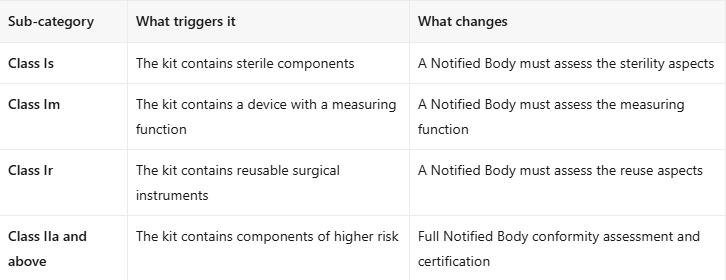 The practical lesson is that sterile components are a classification event, not a packaging detail. A kit that ships with sterile gauze or a sterile wound dressing is no longer in the same regulatory lane as an identical-looking kit that ships with non-sterile equivalents. The contents list and the technical documentation have to move together.
The same is true of every component that carries its own risk profile. Non-EU manufacturers also have a hard precondition that catches people out late in the process: before placing a device on the EU market you must designate an authorised representative established in the Union, with a written mandate. Appointing a representative does not transfer your responsibility for compliance — it gives regulators and market surveillance authorities someone to reach inside the EU.
If you are planning a European range and you are not certain which route your configuration sits on, that is exactly the conversation to have before you order. Send us your content list and we will review it component by component and tell you plainly where the classification pressure points are.
3. The component that surprises people most
Here is where the European picture collides with the direction the rest of the world is moving in.
Over the past two years, three major English-speaking markets have pushed bleeding control from a specialist add-on toward a baseline expectation. Canada's CSA Z1220-24 made a windlass tourniquet mandatory in Type 2 and Type 3 workplace kits. ANSI/ISEA Z308.1-2026, published on 17 September 2026, tightened tourniquet specifications and flagged counterfeit devices as an active concern. UK HSE has signalled support for catastrophic bleed kits in higher-risk environments.
A brand serving global accounts can easily conclude that the right move is to standardise one bleeding-control configuration across every market. That instinct is commercially sound and regulatorily risky, because the same component that satisfies a US or Canadian specification can change your European classification. A kit that was a clean Class I self-declaration can stop being one the moment its configuration moves toward higher-risk trauma components or sterile dressings. That does not make the European market unworkable — it means the decision has to be made deliberately, with the contents list in front of you.
4. EUDAMED: what became mandatory on 28 May 2026
The second front in European compliance is not about classification at all. It is about data.
EUDAMED is the European database on medical devices. Two of its modules — Actor Registration and UDI/Device Registration — became mandatory on 28 May 2026. The practical effect is that the manufacturer must complete the applicable actor and device-data obligations before placing the device on the market.
For importers this changes the due-diligence question. It is no longer sufficient to ask a supplier for a certificate. You now need to know that the manufacturer and the authorised representative are registered as economic operators, that a UDI has been assigned and entered, and that the data on file matches the product you are actually buying.
Three clarifications get misread constantly:
1.Entering data in EUDAMED is not a safety assessment. It is an administrative record, not an approval.
2.An SRN — the Single Registration Number — proves only that an economic operator is registered. It does not demonstrate that a device is compliant, and it is not a device registration number.
3.A Notified Body certificate is not a marketing authorisation. The manufacturer still draws up the Declaration of Conformity and affixes the CE mark.
Under the MDR, no single EU authority grants permission to sell: the manufacturer ensures compliance, and competent authorities perform market surveillance afterwards. That places the burden of being right squarely on the supply chain.
5. The vehicle market: a dated deadline on 1 January 2027
For anyone selling into European automotive, roadside or fleet channels, this is the most concrete event on the calendar.
Greece has confirmed that from 1 January 2027, vehicle first aid kits must comply with the DIN 13164:2022 standard. The requirements include a specified set of sixteen medical devices in prescribed quantities — elastic bandages, wound and burn dressings, fastening and restraint materials, a thermal blanket, cleaning wipes, masks and first aid instructions among them. Individual medical devices such as sterile gauze must carry the CE marking. The outer packaging must also protect the contents from dust and external conditions.
Two consequences follow. First, drivers holding existing kits must either verify that their kit contains all required items in the correct quantities, unexpired and undamaged, or replace it. Second, this is a dated replacement window — the kind of event that moves an entire national aftermarket in a single year.
The official advice is also worth passing to your customers, because it drives refill demand: high temperatures inside a parked car degrade medical materials, so kits should be kept in an accessible location away from direct heat, and their condition should be checked at least every two years.
Greece is not an outlier. Germany's StVZO §35h has long required first aid material in every motor vehicle — roughly 53.5 million vehicles in use, one of the largest mandated vehicle first aid markets in the world, where a compliant DIN 13164 kit retails from around €13. Worldwide, a first aid kit is a legal requirement in somewhere in the region of 56 countries, ranking behind only the warning triangle.
The workplace market runs on the parallel German standard: DIN 13157 for smaller workplaces and DIN 13169 for larger ones, both with established refill ecosystems. Buyers in that channel expect refill packs to be available as a matter of course.
Selling into vehicle, fleet or workplace channels in Europe? Tell us which standard you are specifying against — DIN 13164 for vehicles, DIN 13157 or 13169 for workplaces — and we will map the contents list to the standard and flag any item where the component documentation needs to be verified.
6. Six questions to put to your supplier before you reorder
If a European reorder is coming up, these are the questions that surface problems early rather than at customs:
1.Which MDR class does this configuration sit in, and which component determines it? The answer should name an item, not a category.
2.Are there sterile components, and if so, whose certificate covers them? Sterility is a classification event.
3.Are you and your authorised representative registered in EUDAMED, and what is the UDI? Ask for the registration, not an assurance.
4.Can you supply the Declaration of Conformity that matches this exact contents list? A DoC for a different configuration does not cover this one.
5.For vehicle kits, does the configuration meet DIN 13164:2022 item by item? Quantities matter as much as presence.
6.For workplace kits, is this specified against DIN 13157 or DIN 13169 — and are refill packs available? The refill line is where the repeat revenue lives.
A supplier who answers all six in writing has done this before. A supplier who answers none is placing the compliance burden on you.
7. How we approach European-bound kits
At Yiwu Kebon Healthcare, our European-bound first aid kit ranges — including our workplace medical first aid kit built to MDR and DIN 13157 and our DIN 13157-compliant industrial kit — are supplied on the Class I self-declaration route, as non-sterile configurations without a measuring function. That is the route most workplace and vehicle kits belong on, and it is the route our documentation is built around.
What that means in practice is that we treat the contents list as the compliance document it actually is. Before we quote a European configuration we check it component by component, and if a requested item — a sterile dressing, or a trauma component — would move the classification out of the self-declaration route, we say so at quotation stage rather than after the order ships.
We also supply the categories that sit alongside the kit itself: car emergency rescue kits for the vehicle channel, roadside safety kits for fleet programmes, and medical consumables for the refill programmes that follow every mandated kit replacement.
Our factory holds ISO 13485, CE, FDA and UKCA certification, runs at roughly 100 staff across 5,000 m², works to a MOQ of 500 and a standard production lead time of around 30 days. For European buyers, the practical advantage is not a certificate on a wall — it is a supplier who can tell you which of your SKUs is a Class I self-declaration and which one quietly is not.
8. Frequently asked questions
Does every first aid kit sold in the EU need a Notified Body?
No. A non-sterile kit with no measuring function, containing ordinary low-risk consumables, generally follows the Class I self-declaration route. Notified Body involvement is triggered by higher-risk components, sterility, a measuring function, or a higher classification driven by the contents.
Is adding a sterile dressing really enough to change the class?
Sterile components bring the kit into the Class Is category, where a Notified Body assesses the sterility aspects. The broader classification can also move depending on the component involved. This is precisely why the contents list has to be reviewed as a regulatory document, not just a specification.
Do we need to register anything in EUDAMED?
The manufacturer and the authorised representative register as economic operators, and UDI/device data must be entered before the device is placed on the market. Those obligations became mandatory on 28 May 2026. Registration is a record, not an approval — it does not substitute for conformity assessment.
What exactly changes for vehicle kits on 1 January 2027?
Greece is requiring vehicle first aid kits to comply with DIN 13164:2022, covering sixteen specified devices in prescribed quantities, with CE marking required on individual devices such as sterile gauze. Existing kits must be verified or replaced. Other European countries already mandate vehicle first aid kits under their own national framework — Germany's longstanding rule is the largest example.
Can one bleeding-control configuration serve the US, Canada, the UK and the EU?
It can serve them commercially, but it needs checking market by market. The US, Canadian and UK frameworks push buyers toward tighter bleeding-control specifications, while the EU framework is driven by classification. A single global specification is achievable — but it should be a decision, not an assumption.
We already sell in Europe. What should we do this quarter?
Three things: confirm the classification basis for every SKU you list, confirm that your supplier's EUDAMED and Declaration of Conformity documentation matches the configurations you actually buy, and — if you serve the vehicle channel — begin planning the DIN 13164:2022 transition ahead of 1 January 2027.
Building or reviewing a European product line for 2027? Send us your target configurations and we will return a component-level classification review, the documentation status of each regulated item, and a production schedule with real dates.
Get a quote within 24 hours → Tell us your target market, standard and configuration, and we will send a compliance-mapped proposal — MOQ 500, ~30-day production, certificates included. You can also reach our team through our contact page.
Further reading
**Selling First Aid Kits in the UK in 2026: CE, UKCA and What the New MHRA Reforms Mean for Importers
**ANSI/ISEA Z308.1-2026 Published: What Importers Must Change
**Importing First Aid Kits from China in 2026: US Tariffs, Exemptions, and What Actually Changed
Shop the range
*Workplace medical first aid kits · Industrial first aid kits · Car emergency rescue kits
*Roadside safety kits · First aid boxes · Medical consumables
Send Inquiry




X
We use cookies to offer you a better browsing experience, analyze site traffic and personalize content. By using this site, you agree to our use of cookies.
Privacy Policy
News
 US First Aid Kit Tariffs: The 9 November Exclusion Deadline2026/10/07
The US–China truce runs to 10 January 2027, but 178 Section 301 exclusions expire 9 November. What first aid kit importers must check now.
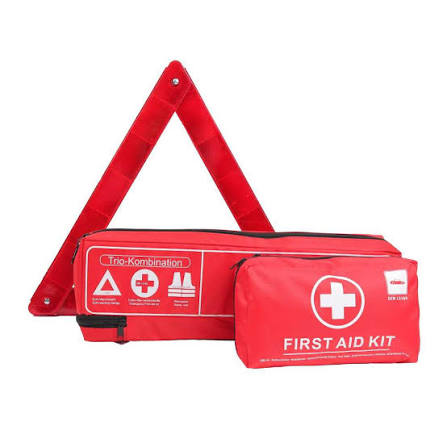 EU MDR First Aid Kits: Classes, EUDAMED and 2027 Car Rules2026/10/07
MDR classes explained for first aid kit importers: Class I, Is and IIa, the 2026 EUDAMED obligations, and the vehicle kit rules taking effect 1 January 2027.