


Call Us
+86-19518020980
Email Us
chloe@kebonfirstaid.com

US-China $30B Tariff Cut Deal: What It Means for Kits
Tariff policy in 2026 has mostly been about defence: extensions, suspensions, and narrowly drawn exclusions that keep costs from rising. This month, for the first time in a while, the conversation moved to offence. On 12 November, China's Ministry of Commerce confirmed at its regular press briefing that the United States and China are in close communication on implementing a reciprocal tariff-reduction arrangement covering roughly 30 billion US dollars of trade in each direction — a framework that, if it lands, would move about 90% of covered products back to most-favoured-nation rates.
For first aid kit importers, this is a different kind of story than the Section 301 exclusions we covered two weeks ago. Exclusions are temporary carve-outs from a tariff wall. This arrangement, if implemented, would lower the wall itself for a defined list of products. The difference matters for how you price, contract and plan 2027.
Here is what is actually on the table, what it means for medical consumables trade, and how to position orders while the details are still being negotiated.
The Framework, as Confirmed So Far
The arrangement has been building through 2026's summit diplomacy:
*May 2026 — at the leaders' meeting in Beijing, the two sides agreed in principle to discuss reciprocal tariff reductions of around $30 billion each, under the Trade Council framework.
*20–23 September 2026 — the eighth round of economic and trade consultations produced consensus on the reduction framework and product lists, with reports that over 90% of covered products would return to MFN rates.
*Early November 2026 — the lead negotiators on both sides held a video call focused on implementation.
*12 November 2026 — the commerce ministry publicly confirmed both sides remain in close communication on implementation details, aiming to bring the arrangement into effect as soon as possible.
The shape of the lists, as reported from the consultations: the US side's list covers around 77 tariff lines of Chinese-origin goods — reported categories include toys, home appliances, baby products and kitchen and bathroom goods. The Chinese side's list covers around 1,619 tariff lines of US-origin goods, with roughly three-quarters agricultural, plus personal care products, coal — and medical devices.
Two structural facts to hold onto. First, implementation requires domestic legal procedures on both sides, and the two governments have committed to synchronised entry into force — no unilateral going first. Second, the arrangement is deliberately sized: $30 billion each way against a bilateral trade relationship measured in hundreds of billions. It is a floor-lowering exercise for selected categories, not a comprehensive reset.
Why the Difference Between "Exclusion" and "Rollback" Matters
If you have been following our tariff coverage all year, your planning model is built on exclusions: temporary, product-specific, renewable-at-the-wire windows like the 178 Section 301 exclusions extended to 9 January 2027. A reciprocal reduction is a different instrument, and the differences drive real decisions:
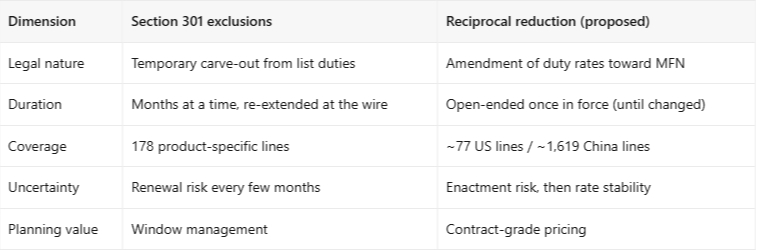
The last row is the commercially important one. An exclusion window lets you time a shipment. A statutory rate reduction lets you price a contract. Distributor agreements, retail listings and annual programmes are all easier to write when the duty line is stable law rather than a renewable grace period.
What It Could Mean for First Aid Kit Importers
Honesty first: we do not yet know whether first aid kits or their components appear on the US-side list of 77 lines. The reported categories — toys, appliances, baby products — are consumer goods, and kit components (gauze, bandages, tapes) have historically lived in different chapters. Until the implementing details publish, nobody should build a margin model on inclusion.
What a serious importer does with that uncertainty:
1. Treat it as free optionality, not a plan. The correct posture is to keep current pricing on the existing duty structure — MFN base plus applicable Section 301 layers, with the 178 exclusions honored where they apply through 9 January — while noting in your planning that a floor reduction may arrive in 2027. If your lines are included, it is margin upside; if not, you planned honestly.
2. Watch the synchronisation mechanics. Because both sides enter force together, the trigger will be visible: domestic procedures in Washington and Beijing conclude, then rates change by notice. Customs entries before the effective date pay the old rates. The entry-date principle we keep repeating — eligibility follows entry for consumption, not shipment — will apply to this transition too.
3. Mind the interaction with the January cliff. The truce window, the 178 exclusions and the maritime fee suspension all converge on 9–10 January 2027. The reduction arrangement is the obvious candidate to replace short-term extensions with something more durable — or to fail and leave the roll-over machinery running. Either way, the first weeks of January decide which world 2027 pricing lives in.
4. Use the window for structural conversations. If your programme runs on annual pricing, this is the moment to renegotiate duty-sharing clauses: define what happens if a covered line's rate drops, and who captures the difference. Factories and importers who settle this in advance split gains cleanly instead of arguing retroactively.
If you want a factory on your side of that conversation — one that quotes FOB cleanly and helps you model duty scenarios per configuration — send us your kit list and destination market, and we will put the sourcing numbers next to your tariff assumptions.
The 2027 Tariff Calendar, Consolidated
As of 16 November 2026, the US–China tariff calendar for kit importers looks like this:
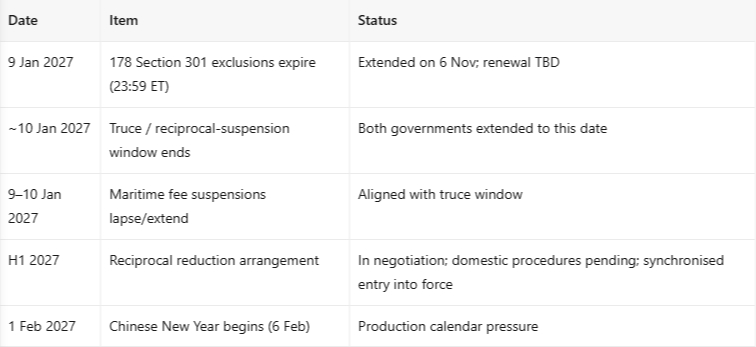
One more piece of background matters for reading this correctly: in February 2026, the US Supreme Court ruled the bulk IEEPA-based tariffs unlawful, and the administration has been rebuilding its China tariff structure on Section 301 authority. A negotiated reduction is easier to sustain across legal regime changes than litigation-built layers — which is exactly why both governments keep the $30 billion framework alive even while the exclusion roll-overs grind on month to month.
Who Captures the Saving — the Question Behind the Question
Whenever a tariff reduction is rumoured, the same negotiation plays out between importers and their distributors: who keeps the benefit? The answer is decided by contract structure, not by the tariff notice. Three archetypes we see in kit programmes:
Fixed-price contracts. The importer quoted an annual landed price in October; the rate drops in March. The distributor pockets the difference unless the contract has a duty-adjustment clause. If you sell on fixed annual pricing, write the clause before the arrangement lands, not after.
FOB-plus-freight programmes. The importer holds the duty line and passes savings to customers at its own discretion. This is the structure that benefits most from policy moves — and the reason we quote FOB as standard practice.
Retail listing programmes. Marketplaces and retail chains increasingly require cost-down justifications annually. An MFN restoration on covered lines is a legitimate, documentable cost reduction — worth having in writing when your category manager asks.
None of this requires predicting whether your lines are covered. It requires deciding now who benefits if they are.
A Word of Caution on Headline Numbers
Reported figures around this arrangement — 77 lines, 1,619 lines, 90% to MFN, $30 billion each way — come from consultation summaries and ministry press briefings, not from published tariff schedules. They are directionally reliable and contractually unusable. Before any pricing decision, wait for the implementing notices: the actual Federal Register and State Council Tariff Commission publications, with real HTS codes and effective dates. Every tariff story this year has taught the same lesson — the headline arrives first, the operative text arrives later, and the difference between them is where margin lives or dies.
Quick Answers
Does this replace the Section 301 exclusions?
Not automatically. The exclusions and the reduction arrangement are separate instruments. If the reduction covers a line, its MFN-level rate would make the exclusion redundant for that line — but until the arrangement is law, the exclusions remain the operative protection, extended through 9 January 2027.
Are first aid kits on the US-side list?
Not confirmed in any published detail so far. The reported 77 US lines lean toward consumer categories. Treat inclusion as unknown until the implementing notice publishes with HTS codes.
What happens if the arrangement fails to land?
The existing machinery continues: exclusion roll-overs every few months, the truce window ending 10 January, and structural duties unchanged. Your January planning should not assume the arrangement as a given.
How We Help Buyers Price Through Policy Cycles
We manufacture first aid kits in Yiwu for importers across the US, Europe, the Middle East and Canada — ISO 13485, CE, FDA and UKCA registered, about 100 people across 5,000 square meters, MOQ 500 per SKU, roughly 30-day standard lead time. Policy cycles are standing agenda items in our customer reviews, and three practices are built into how we quote:
*FOB discipline. We quote product FOB and keep duty assumptions out of our price, so when the rate floor moves, your model updates in one cell — not through a renegotiation.
*Documentation that survives scrutiny. Clean component declarations and consistent descriptions across invoice, packing list and HTS classification — the raw material your broker needs for any exclusion, reduction or ruling question.
*Production timing against policy dates. When a buyer wants cargo to clear inside or outside a specific window, we schedule backwards from the entry date, the same discipline we applied to the November extension.
If your 2027 range needs a supplier who prices cleanly through policy noise, request a quote with your target market and annual volume. The $30 billion arrangement may or may not include your lines — but a factory that helps you plan for both outcomes is worth having either way.
Further Reading
*Section 301 Exclusions Extended to January 9, 2027 — the two-month window this arrangement may eventually replace.
*US First Aid Kit Tariffs: The 9 November Exclusion Deadline — the two-clocks framework that still governs January planning.
*After 9 November: New Landed Costs for First Aid Kits — the scenario model, reusable for the January decision point.
Questions about duty scenarios for your configurations? Contact our export team — we reply within one business day.
Send Inquiry




X
We use cookies to offer you a better browsing experience, analyze site traffic and personalize content. By using this site, you agree to our use of cookies.
Privacy Policy
News
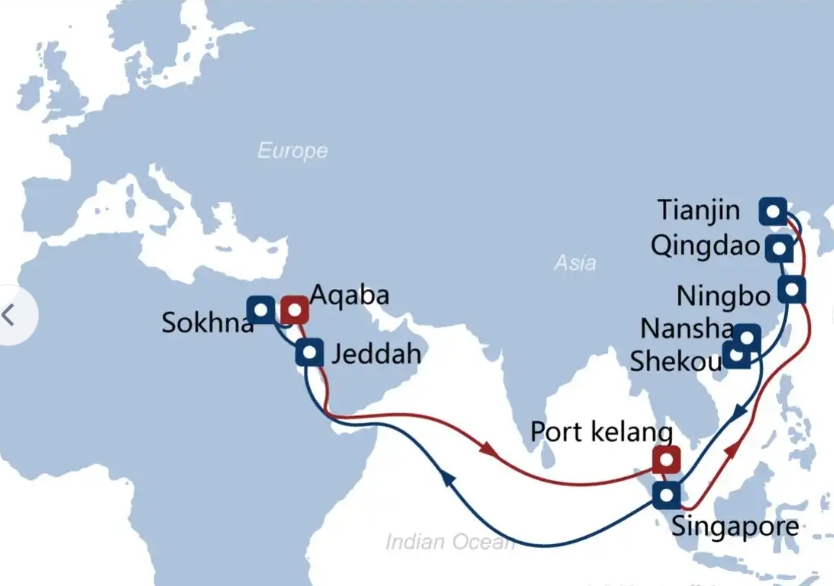 China-Saudi Direct Shipping Route Cuts Transit 2-3 Weeks2026/11/18
A direct Taicang-Jeddah container route opened in October, cutting China-Saudi transit by 2-3 weeks. What it means for Gulf first aid kit importers.
 US-China $30B Tariff Cut Deal: What It Means for Kits2026/11/18
Washington and Beijing are negotiating reciprocal tariff cuts on $30 billion of trade each way. What the arrangement could mean for first aid kit importers.