


Call Us
+86-19518020980
Email Us
chloe@kebonfirstaid.com

China-Saudi Direct Shipping Route Cuts Transit 2-3 Weeks
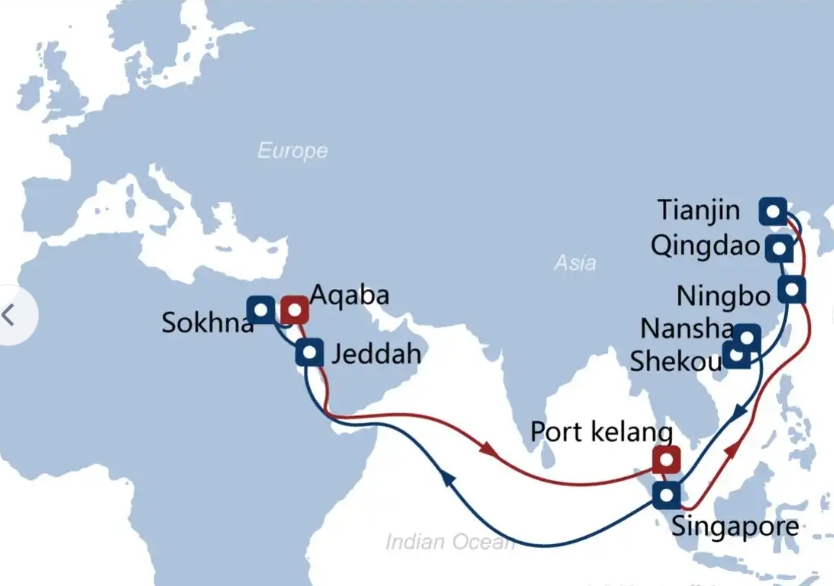
Trade between China and the Arab world reached 422 billion US dollars in 2025, Belt and Road cooperation documents now cover all 22 Arab states, and the logistics layer underneath that trade is being rebuilt — route by route. The latest and most relevant change for Gulf-bound cargo: a direct container shipping route linking Taicang Port in Suzhou with Jeddah, Saudi Arabia, opened in October 2026 and cutting transit time by two to three weeks compared with previous routings.
Two to three weeks is not an incremental improvement. For first aid kit importers in Saudi Arabia and the wider Gulf, it compresses the entire replenishment cycle — production, shipping, customs, shelf — by the same margin. Combined with the Suez Canal recovery we covered last week, the China–Middle East leg of a kit supply chain is entering its most efficient state since 2023.
Here is what the route change means in practice, how it fits the broader Middle East logistics picture, and how to structure orders to capture it.
What Changed on the Water
The new Taicang–Jeddah service matters for three reasons:
It removes transshipment risk. Gulf-bound containers from East China have typically moved via transshipment hubs — a second loading, a second schedule, a second set of delay scenarios. A direct loop eliminates the transshipment leg entirely, which is where a large share of "my container missed its connection" stories originate.
It targets the largest Gulf consumption market. Jeddah is the gateway to Saudi Arabia's Red Sea coast and its western industrial and population centers — and, via land corridors, to Riyadh. For kit distributors serving Saudi workplace, healthcare and retail channels, a direct China connection to their home port is a structurally better supply line.
It is part of a broader normalization. The route opened as the Suez Canal returned to mainstream service: Maersk and Hapag-Lloyd routed their Gemini network's ME1 service back through the canal in early November, Evergreen restarted its China–Red Sea service on 12 November, and by late October roughly 60% of Asia–Europe capacity had returned to Suez transits. Cargo bound for Jeddah, Jebel Ali or Aqaba rides the same restored corridors — and avoids the 10–14 day Cape of Good Hope penalty that Gulf cargo paid through the diversion era.
For context on how big this trade is becoming: at the recent China–Arab business dialogue, entrepreneurs from more than 200 Chinese and Arab firms shared the table, and Chinese equipment suppliers described Saudi port infrastructure as one of their fastest-growing markets. The shipping lines are simply following the cargo.
What Two to Three Weeks Does to a Kit Supply Chain
A first aid kit programme in the Gulf typically runs: production in China (about 30 days for us), ocean transit (historically 30–40 days to Gulf ports depending on routing and transshipment), customs and registration checks, then distribution. Trim three weeks off the middle and three things become possible:
1. Leaner safety stock. If your replenishment cycle was sized to 70+ days of transit-plus-production, a direct-route cycle lets you hold less inventory in Dammam, Jeddah or Jebel Ali warehouses without raising stockout risk. Working capital previously parked in buffer stock comes back to the business.
2. Faster corrective cycles. When a kit configuration needs a fix — a label correction, an Arabic insert revision, a regulatory-driven content change — the shorter loop means the corrected batch reaches shelves weeks sooner. In regulated categories like first aid, that responsiveness is worth more than the freight saving itself.
3. Realistic seasonal timing. Ramadan, Hajj-season demand, school-year restocking and winter tourism peaks in the Gulf all reward importers who can hit narrow windows. A two-to-three-week shorter, transshipment-free line converts "probably" into "plannable" for those calendars.
Pair the freight gain with the compliance side and the picture completes: Gulf-bound kits also face the region's device registration and labeling requirements — SFDA registration in Saudi Arabia, EDE registration in the UAE, Arabic labeling — which we have covered in detail for Saudi and UAE compliance and for the UAE's EDE registration transition. Faster shipping does not waive faster paperwork; the factories who win Gulf programmes are the ones who run both clocks together.
If you are building or expanding a Gulf distribution programme, send us your destination ports and target volumes, and we will propose a production and shipping plan matched to the new route economics — including the registration documentation your customs broker will ask for.
How to Structure Orders Around the New Line
Three moves we recommend to Gulf customers booking for 2027:
1. Ask your forwarder for the direct service by name. Direct routes run on specific loops with specific cut-offs. When quoting, specify the Taicang–Jeddah-type direct services (and their North China and South China equivalents) rather than accepting a cheapest-transshipment quote that quietly reintroduces the delay you just removed.
2. Split urgent and cost shipments. The direct line favors reliability over rock-bottom pricing; transshipment options still win on rate in soft markets. A two-track booking pattern — direct for the core replenishment calendar, spot transshipment for opportunistic volume — captures both.
3. Re-time your restock against Ramadan 2027. Ramadan begins around 8 February 2027, immediately after Chinese New Year closures (6 February) — the hardest overlap of the year for China-Gulf supply. A direct-route shipment produced in December and sailed in January lands with weeks to spare; a transshipment-dependent plan does the same trip with less margin for error. This is the single most common planning error we help Gulf customers avoid.
The Freight Math: Direct Services Cost More per Box and Less per Programme
Buyers sometimes compare a direct-service quote against a transshipment quote per container and stop there. That comparison is incomplete. Run the full math and the direct service usually wins:
Inventory carrying cost. Three extra weeks of transit is three extra weeks of capital sitting on the water. At typical landed values for a container of workplace kits, the carrying cost of the delay alone can offset a meaningful share of the headline rate difference — before counting the buffer stock it forces you to hold ashore.
Damage and loss exposure. Every transshipment is an extra crane move, an extra restow, an extra custody transfer. Kits ship in retail-ready cartons; corner damage that a warehouse pallet survives can fail a retail listing. Fewer touches, fewer claims.
Schedule reliability. Direct loops publish fixed cut-offs and sailings; transshipment plans inherit two schedules and two sets of blank-sailing decisions. In the current market — carriers cancelling single-digit percentages of sailings weekly to defend rates — one schedule is materially easier to plan around than two.
The claim and rework cost of late arrivals. Gulf retail channels impose delivery windows; miss them and the penalties or delisting risks dwarf freight savings. The direct service is, among other things, an insurance policy on your delivery commitments.
None of this makes the direct service right for every container. It makes it right for the containers whose timing matters — which, for most kit programmes, is most of them.
Quick Answers from Gulf-Bound Shippers
Does the direct route serve ports beyond Jeddah?
As launched, the service links Taicang with Jeddah — the Red Sea gateway. Cargo for Riyadh typically moves overland from Jeddah; Eastern Province destinations are usually served through Dammam on different loops, and UAE cargo through Jebel Ali. Ask your forwarder which direct loops cover your specific port, and expect the network to expand as carriers re-deploy capacity.
Is the Suez return safe to plan around?
Plan around it, with a contingency. The majority of Asia–Europe and Gulf corridor capacity is back in the canal, but security conditions could force re-diversion — a scenario that adds days and rate pressure quickly. Keep one priced fallback routing per programme.
Do faster routes change what customs expects?
No. Faster ships do not simplify SFDA or EDE registration, Arabic labeling, or documentation checks — if anything, they surface compliance gaps sooner because your timeline has less slack. Treat the freight gain and the compliance calendar as one integrated plan.
What is the best production-to-sail window for Ramadan 2027 stock?
Produce in November–December, sail in December–January, clear and distribute in January. Chinese New Year closures begin 6 February and Ramadan follows almost immediately — anything not on the water by mid-January is gambling with post-CNY capacity and the last pre-Ramadan retail window.
What Actually Sells in the Gulf Right Now
Route economics aside, it is worth grounding this in product reality — what we see moving in volume for Gulf customers this year:
Vehicle and roadside kits built for heat. Extreme cabin temperatures are hard on adhesive bandages, antiseptic wipes and case materials. Gulf-market vehicle kits need heat-stable component specifications and UV-resistant cases — a sourcing conversation worth having before the first summer, not after the first claim.
Workplace programmes scaled to Saudization and mega-projects. Construction, logistics and hospitality employers across the Kingdom and the UAE are standardizing on medium and large workplace kits with trauma extensions — the same bleeding-control upgrade we documented for UK and US buyers, arriving in Gulf procurement specifications on a slight delay.
Hajj and Umrah season public-health kits. Crowd-density events drive public and private demand for compact personal kits, hydration-related supplies and basic wound care — a seasonal line with predictable timing and high repeat purchase.
Ramadan retail multipacks. Family-size kits positioned around the pre-Ramadan home-preparation season perform consistently in modern trade channels, provided Arabic-first packaging and clear expiry dating are built in from the sample stage.
Each of these lines shares one production requirement: market-specific configurations locked early, so the faster shipping cycle actually delivers the right product — not just the same product sooner.
Where the Middle East Logistics Story Goes Next
Three developments to watch into 2027:
*Suez recovery depth. Drewry projects canal transits at about 80% of normal by February 2027. The closer that gets to 100%, the more the restored Gulf corridors consolidate their advantage.
*More direct China–Gulf loops. The Taicang–Jeddah service follows the trade data; expect additional direct loops from North and South Chinese ports to Gulf gateways as carriers re-deploy capacity freed by the Suez return.
*Regulatory deepening. SFDA and EDE registration regimes are maturing in parallel with the logistics upgrade — the UAE's move to EDE marketing authorisation being the clearest example. The Gulf market is becoming simultaneously easier to reach and more formal to enter. That combination favors organized importers with compliant factories.
We manufacture first aid kits in Yiwu — ISO 13485, CE, FDA and UKCA registered, roughly 100 people across 5,000 square meters, MOQ 500 units per SKU, about 30 days' standard lead time — and the Gulf is one of our fastest-growing markets. Our documentation packs are built for SFDA and EDE registration paths, with Arabic labeling support, and our production calendar is planned around Gulf seasonal windows. If that combination fits your programme, request a quote from our export team — include your destination port and we will respond with a costed, calendar-matched plan.
The distance between Yiwu and Jeddah has not changed. The time has. In a trade where shelf availability and registration deadlines both run on calendars, time is the advantage.
Further Reading
*Suez Canal Return: First Aid Kit Freight Outlook 2027 — the restored corridors this route rides on.
*GCC First Aid Kit Rules: Saudi Arabia and UAE Compliance — the paperwork layer for Gulf-bound kits.
*UAE Medical Device Registration: EDE Explained — the UAE authorization transition in detail.
Questions about Gulf shipping schedules or registration documentation? Contact our export team — we reply within one business day.
Send Inquiry




X
We use cookies to offer you a better browsing experience, analyze site traffic and personalize content. By using this site, you agree to our use of cookies.
Privacy Policy
News
 China-Saudi Direct Shipping Route Cuts Transit 2-3 Weeks2026/11/18
A direct Taicang-Jeddah container route opened in October, cutting China-Saudi transit by 2-3 weeks. What it means for Gulf first aid kit importers.
 US-China $30B Tariff Cut Deal: What It Means for Kits2026/11/18
Washington and Beijing are negotiating reciprocal tariff cuts on $30 billion of trade each way. What the arrangement could mean for first aid kit importers.