


Call Us
+86-19518020980
Email Us
chloe@kebonfirstaid.com

Australia & New Zealand Shipping Alert: Capacity Cuts in July–August – Shippers Urged to Book at Least 10 Days in Advance Maersk cancels two Northern Star voyages as Asia–Oceania capacity tightens amid early peak season demand
Australia & New Zealand Shipping Alert: Capacity Cuts in July–August – Shippers Urged to Book at Least 10 Days in AdvanceMaersk cancels two Northern Star voyages as Asia–Oceania capacity tightens amid early peak season demandDATE: July 14, 2026
Shippers with cargo destined for Australia and New Zealand are being urged to book space at least 10 days in advance as capacity on the Asia–Oceania trade lane tightens significantly throughout July and August 2026. Major carriers have implemented voyage cancellations and capacity reductions, while an unexpectedly early peak season has driven vessel utilisation rates to near-full capacity, creating a "space-first" market dynamic where securing bookings has become the primary challenge.Voyage Cancellations: What You Need to KnowMaersk, one of the largest carriers on the Asia–Oceania route, announced in late May the cancellation of two scheduled voyages on its Northern Star Service (also known as the Polar Star/PII service) for July and August. The decision was attributed to "seasonal cargo volume fluctuations" on the Asia–Oceania route.
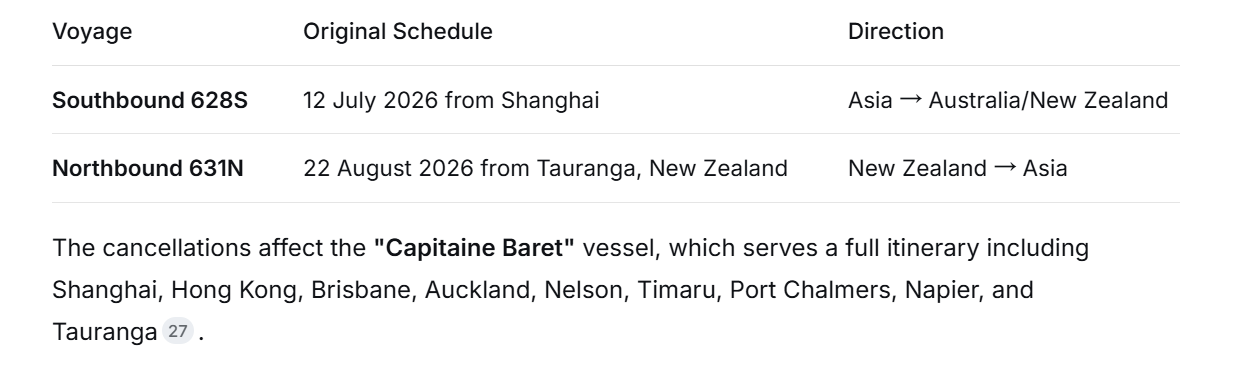
Impact on Shippers
The cancellation of these two voyages means overall capacity on the Asia–Australia and New Zealand route has been reduced for the period from mid-July through late August. While July–August is traditionally a slower season for Asia–Oceania exports, this year's market presents unique challenges:
1. Early Peak Season DemandAn early peak season has emerged across Asia-origin trades, with vessels operating at full capacity on routes to Oceania. Container demand from Asia increased sharply after the May holiday period, while available capacity has remained restricted. Space shortages are particularly evident in China and Southeast Asia, where most vessels are already fully booked into late June.
2. "Space, Not Rate" Becomes the Core IssueUnlike previous cycles where freight rates led the market narrative, the current dynamic is defined by capacity shortages. The market has shifted from "smooth shipping" to "racing for space," with booking windows shrinking significantly. Freight forwarders report that "as soon as space is released, it fills up instantly".
3. Rising Rates and SurchargesFreight rates on the China–Australia lane have surged approximately 68% cumulatively since mid-March. Spot rates from Shanghai to Sydney have reached US$2,634 per FEU, with month-on-month increases of 15–25% in June alone. Carriers are also implementing peak season surcharges:
ANL (CMA CGM): Rate restoration of US$300 per 20' dry** and **US$600 per 40' dry for North-East Asia to New Zealand, effective 22 July 2026
ANL: Peak Season Surcharge of US$300/TEU for South-East and South Asia to Australia, effective July 2026
MSC: Peak Season Surcharge of US$500/TEU for South-East and South Asia to Australia, effective 1 July 2026
OOCL: Peak Season Surcharge of US$500/TEU for North-East Asia to Australia, effective 2 July 2026
Forwarders are now being quoted approximately US$2,000 per TEU for Far East–Australia shipments, highlighting the severity of the capacity shortage.
4. Exceptions and Alternative ArrangementsBrisbane-bound cargo is the exception: Maersk has arranged temporary weekly capacity from Shanghai and Hong Kong to Brisbane throughout the suspension period, ensuring service continuity for this port.
5. Impact on New Zealand Reefer/ CargoThe cancelled northbound 631N voyage will particularly affect New Zealand's chilled and frozen exports—including dairy products, meat, and fruit—destined for Asian markets. Shippers of refrigerated cargo should immediately confirm alternative vessel schedules and reefer equipment availability with their carriers.
Air Freight Capacity Also Under Pressure
The capacity crunch extends beyond ocean freight. Multiple airlines have reduced or suspended Australia and New Zealand passenger services, which directly impacts belly-hold cargo capacity.China Eastern Airlines has reduced Australia–New Zealand capacity, freeing 3–4 A330-200 aircraft per week for redeployment to European routes
China Southern Airlines has suspended its Shenzhen–Sydney serviceHong Kong Airlines reduced Sydney and Melbourne capacity by approximately 18% in May and June
Air New Zealand has made schedule changes for July, including on Australian flights, due to high jet fuel costs
The Hangzhou–Sydney–Auckland route has suspended its twice-weekly flights from 10 May to 24 October 2026With direct passenger flights reduced, belly-hold capacity has contracted directly, while all-cargo aircraft resources—already scarce in second-tier cities—cannot quickly fill the gap.Booking Recommendations
Given the capacity reductions and early peak season demand, shippers are strongly advised to take the following actions immediately:
✅ Book at least 10 days in advanceSpace is tightening across the Asia–Oceania trade. Industry sources recommend booking at least 10 days ahead of the intended sailing date. For shippers planning to move cargo from mid-July through late August, immediate action is critical.
✅ Lock in long-term contract spaceFor businesses with regular shipping schedules, securing long-term space agreements with carriers is the most reliable way to guarantee capacity and price stability.
✅ Prioritise "space protection" over rate negotiationIn the current market, the core challenge is securing space, not negotiating rates. Shippers should prioritise "space protection and on-time delivery" above all else.
✅ Consider alternative portsIf space is tight at major ports such as Shanghai or Ningbo, consider routing via Brisbane, Adelaide, or other ports where service continuity is more stable.
✅ Confirm reefer capacity for New Zealand exportsShippers of refrigerated cargo from New Zealand should immediately confirm alternative vessel schedules and cold-chain equipment availability with their carriers.
✅ Build buffer time into supply chainsWith booking windows shrinking and the risk of rollovers increasing, supply chain planners should add significant buffer time to their delivery schedules.OutlookWhile the current capacity reductions are partly attributable to seasonal adjustments, the combination of early peak season demand, carrier capacity cuts, and broader geopolitical uncertainties suggests that space on the Asia–Oceania trade lane will remain tight through at least the end of August.
Carriers are expected to continue adjusting capacity dynamically in response to market conditions. Shippers are advised to maintain close communication with their freight forwarders and carriers, monitor schedule updates regularly, and build flexibility into their contracts to accommodate potential voyage changes.About This AdvisoryThis advisory is intended to help shippers, freight forwarders, and logistics professionals navigate the capacity challenges on the Australia and New Zealand trade lane during July–August 2026. The information contained herein is based on publicly available data as of July 14, 2026, and is subject to change as the situation develops.Media Contact:
Chloe
Chloe@kebonfirstaid.com
Send Inquiry



X
We use cookies to offer you a better browsing experience, analyze site traffic and personalize content. By using this site, you agree to our use of cookies.
Privacy Policy
News
 ANSI/ISEA Z308.1-2026: What the New US First Aid Kit Standard Means for Importers and Brands2026/09/09
ANSI/ISEA Z308.1-2026 adds optional naloxone, bilingual guidance and stricter tourniquet rules. What US-bound first aid kit buyers must change now.
 Importing First Aid Kits from China: 2026 Tariff Guide2026/09/09
Are first aid kits exempt from the new US tariffs on China? 2026 rates, the exemption list, HS-code rules and landed-cost tips for importers.